
In short
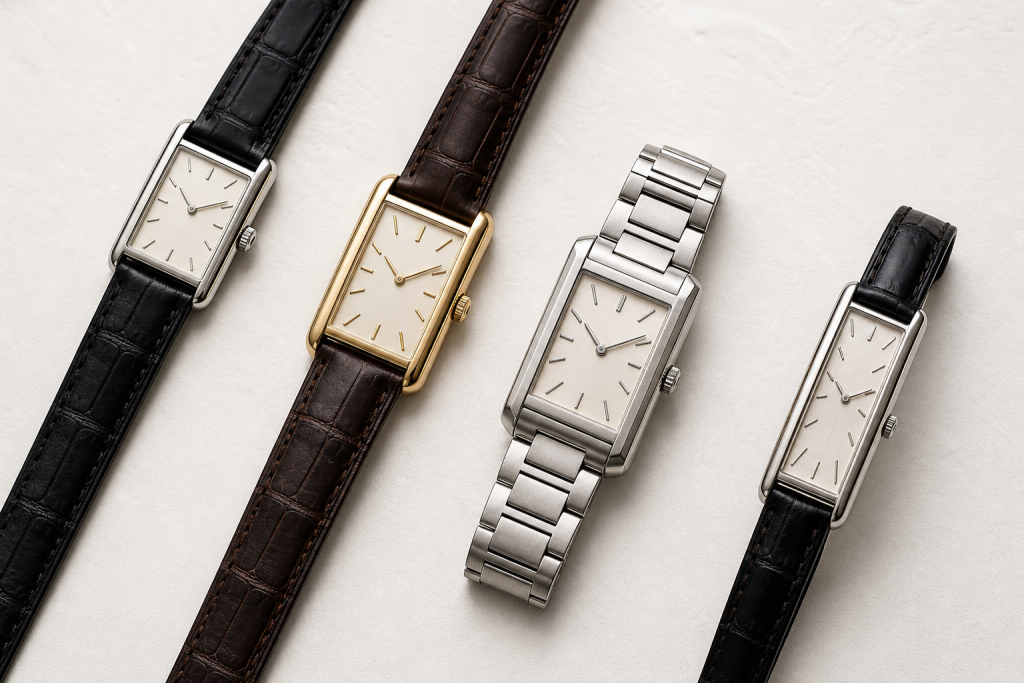
A Cartier Tank watch is best chosen by shape and proportion first, then by material and movement. The Tank Must is the practical steel entry point; the Tank Louis Cartier is the traditional precious-metal expression; the Tank Française adds an integrated bracelet; and the Tank Américaine is longer and more curved.
- The name “Tank” covers several distinct case shapes, not one interchangeable watch design.
- Cartier’s representative small Tank Must and Tank Louis Cartier models both measure 29.5 mm by 22 mm, yet material and movement make them very different purchases.
- A Tank Française suits buyers who want a bracelet-led watch, while a Tank Américaine has a noticeably longer, curved profile.
- Official Cartier catalog pricing spans from steel quartz Tank Must examples to precious-metal Tank Louis Cartier models, with configuration and market affecting the final price.
- For a pre-owned Cartier Tank, verify the reference, dimensions, movement, condition, included accessories, and the dealer’s payment and return terms before committing.
Contents
- Which Cartier Tank family fits how you dress?
- What Cartier Tank size should you choose?
- Should you choose quartz, SolarBeat, or mechanical?
- What should you verify before buying a Cartier Tank?
- Frequently asked questions
Which Cartier Tank family fits how you dress?

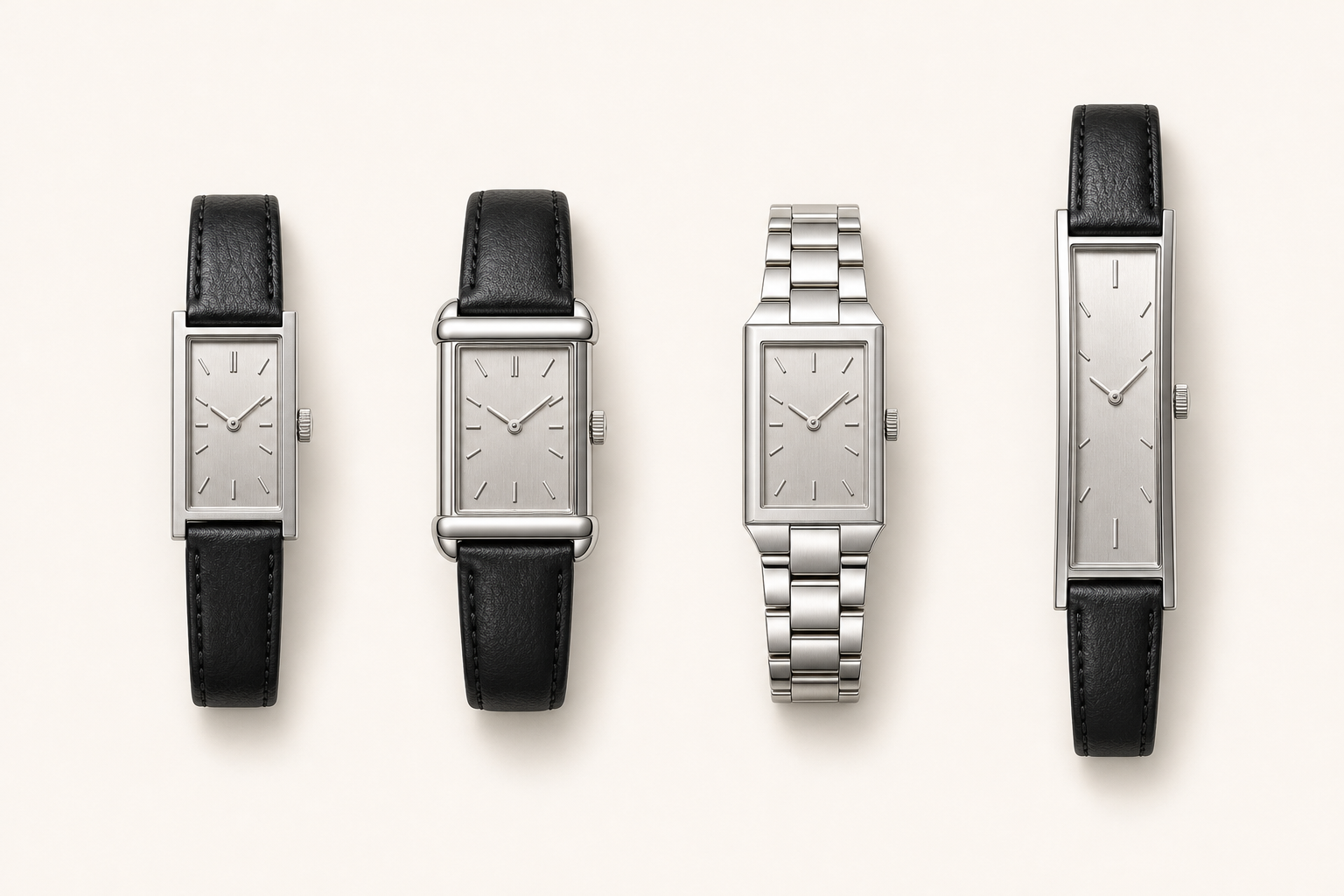
The right Cartier Tank family depends less on a broad label such as “dress watch” and more on the line you want the case and strap or bracelet to create. Cartier traces the Tank to a 1917 design by Louis Cartier, and the family has since been interpreted in several distinct forms. Cartier’s Tank collection description identifies the Cintrée, Chinoise, Américaine, and Française among those interpretations. (cartier.com)
Tank Must: the simplest route into the design
The Tank Must is the place to start if the essential Tank look matters more than precious metal or a hand-wound caliber. Steel cases, leather straps, quartz options, and SolarBeat photovoltaic versions make this family the most straightforward current expression of the classic rectangular dial.
A representative small SolarBeat Tank Must measures 29.5 mm long by 22 mm wide and 6.6 mm thick. Cartier specifies a steel case, black calfskin strap, and 3-bar water resistance for reference WSTA0137. See the official Tank Must specifications. (cartier.com)
Tank Louis Cartier: the classic precious-metal choice
The Tank Louis Cartier is closer to the formal, traditional image many buyers have in mind when they picture a Cartier Tank. Rounded brancards, a leather strap, precious metal, and either quartz or hand-wound mechanical movements define the family.
For example, Cartier lists a small hand-wound rose-gold Tank Louis Cartier at 29.5 mm by 22 mm and 6.8 mm thick. The similar footprint to a small Tank Must is a useful reminder that size alone does not describe the character of a watch. Cartier’s Tank Louis Cartier product page gives the full reference-level specifications. (int.cartier.com)
Tank Française: the bracelet-led option
The Tank Française changes the feel of the design by carrying the case directly into a linked metal bracelet. Cartier describes the curved case as sitting at the center of the bracelet so that the lines flow together, which makes the Française a stronger option for everyday bracelet wear than a leather-strap Tank. (int.cartier.com)
A current small steel quartz example is 25.7 mm by 21.2 mm and 6.8 mm thick. That is compact, but the bracelet gives it more visual presence across the wrist than the numbers alone suggest.
Tank Américaine: the long, curved interpretation
The Tank Américaine is the choice for buyers who like the Tank idea but want a more elongated case. Cartier describes it as having a pronounced curve, with alternating rounded edges and angles. (int.cartier.com)
One small rose-gold example measures 35.4 mm by 19.4 mm and 6.8 mm thick. Its narrow width keeps the watch refined, while the additional length makes it read very differently from the more compact Must or Louis Cartier.
Choose the Tank family by its silhouette and wearing style first, because a bracelet, a curved profile, or precious-metal case changes the experience more than a shared dial layout does.
What Cartier Tank size should you choose?
Cartier Tank sizing should be read as length by width, not as a single diameter. A rectangular 29.5 mm by 22 mm case can wear more formally and more visibly than its width suggests, while a 35.4 mm by 19.4 mm case can look slim but extend farther along the wrist.
The most useful comparison is a watch you already wear comfortably. Measure its lug-to-lug length if it is round, then compare that dimension with the Tank’s case length. A photo on a seller’s wrist is helpful only when the wrist circumference is supplied, because the same Tank can look understated on one wrist and long on another.
The following representative official dimensions show why a Tank comparison needs two measurements:
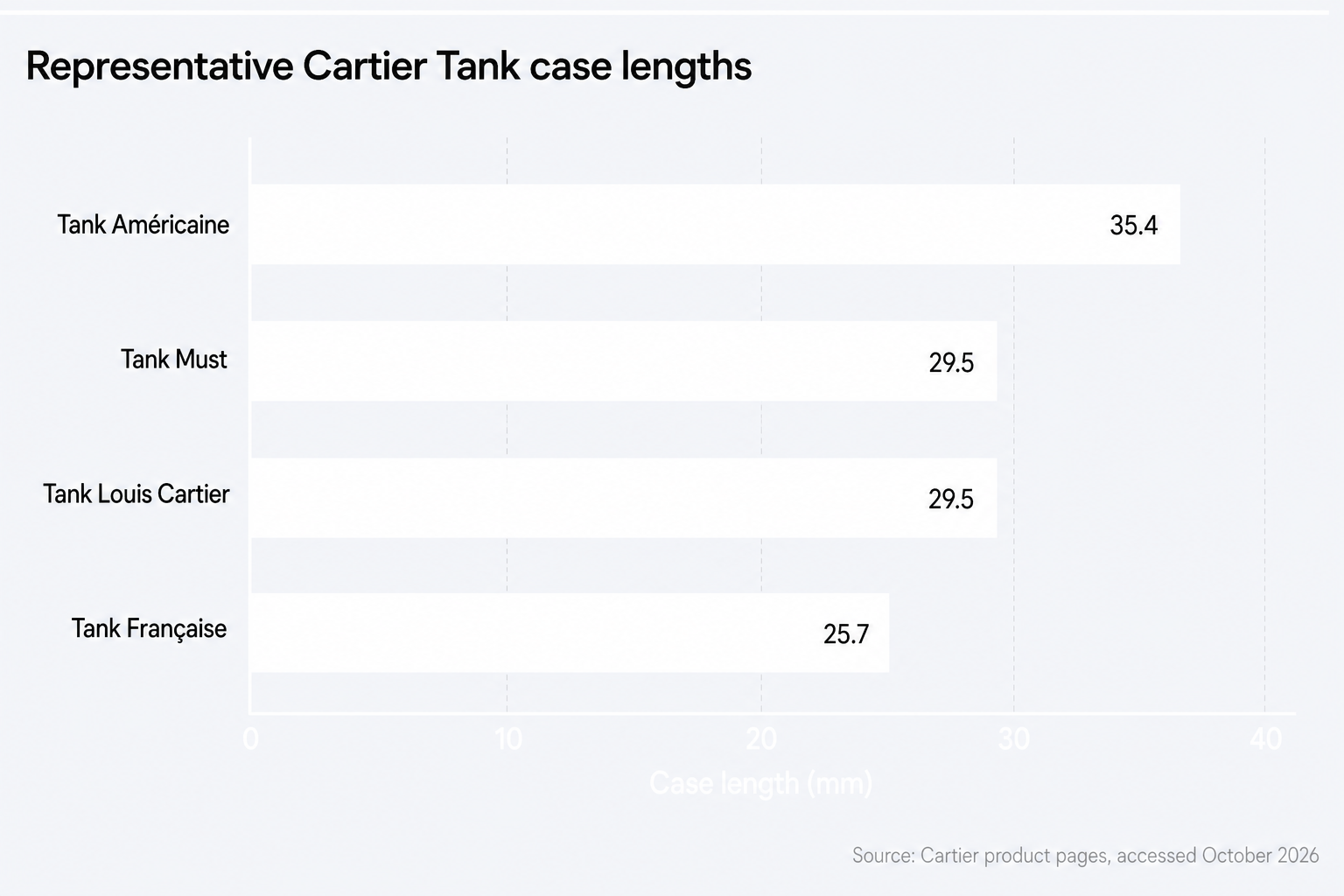
Use the width as a first filter for visual restraint, then use length to judge whether the case will sit within the flat part of your wrist. The 25.7 mm by 21.2 mm Tank Française is the most compact representative here. The 35.4 mm by 19.4 mm Tank Américaine is the longest, though it is also the narrowest. The small Tank Must and small Tank Louis Cartier both measure 29.5 mm by 22 mm in the cited configurations. (cartier.com)
Do not buy a Tank by width alone: compare case length, width, thickness, strap or bracelet, and a wrist shot from the actual listing.
Should you choose quartz, SolarBeat, or mechanical?
Choose the movement based on how you expect to wear and maintain the watch. Quartz is practical for regular or occasional wear, SolarBeat offers a light-powered quartz alternative in selected Tank Must references, and mechanical movements appeal to buyers who want a more traditional winding ritual.
Quartz is usually the least demanding choice. The representative Tank Must and Tank Française references cited above use quartz, while Cartier also offers SolarBeat photovoltaic Tank Must configurations. Cartier identifies the SolarBeat small model as a photovoltaic movement, rather than a conventional mechanical caliber. (cartier.com)
A hand-wound Tank Louis Cartier is a different proposition. Cartier identifies the small rose-gold reference WGTA0010 as using its manual-winding 8971 MC caliber. (int.cartier.com) A buyer who rotates several watches may enjoy that interaction; a buyer who wants to pick up a watch and leave without resetting it may prefer quartz.
Movement type should support your routine, not an abstract hierarchy: the better Tank is the one you will enjoy wearing and keeping correctly.
What should you verify before buying a Cartier Tank?

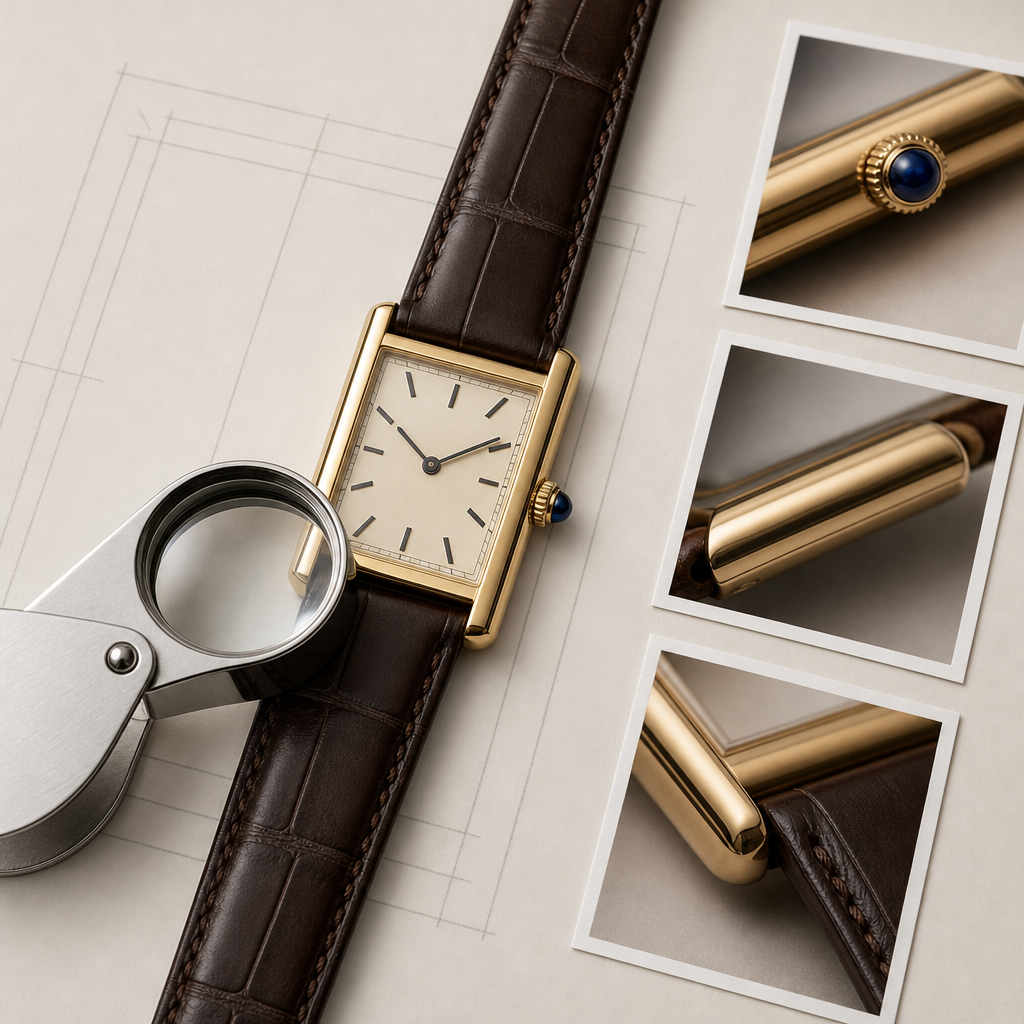
A Cartier Tank listing should give enough detail for you to identify the exact watch, not merely the collection name. Ask for the reference, case dimensions, movement type, material, condition images, included accessories, and the dealer’s own payment and return terms before deciding.
Start with the reference number. “Tank Must,” “Tank Louis Cartier,” and “Tank Française” each cover numerous configurations, so the reference is the fast route to the right dimensions, movement, dial, and material. Compare the information in the listing against Cartier’s own reference-level description where it is available.
Then inspect the points that photographs can hide or flatter:
- Case and brancards: Look for dents, deep polishing, softened edges, and uneven finishing around the vertical sidebars.
- Dial and hands: Confirm that the dial condition, print, minute track, and blued hands match the listing photographs and the represented reference.
- Crown and cabochon: Cartier specifications commonly describe a sapphire or synthetic spinel cabochon, depending on the model. Ask for a close image rather than assuming every blue crown detail is identical. (int.cartier.com)
- Strap or bracelet: Determine whether it is original, replacement, stretched, or missing links. Bracelet condition matters especially on the Tank Française.
- Set and documentation: Ask exactly what is included. “Full set” should mean the seller identifies the box, papers, warranty material, and any service documentation rather than using a vague label.
A marketplace listing can help you compare references, materials, case shapes, and available dealer inventory. Browse Cartier Tank and other current dealer listings on DreamChrono. Confirm the seller’s terms directly, particularly where a purchase depends on condition, documentation, shipping, or return arrangements.
A good Cartier Tank purchase begins with a precise reference and ends only after the listing evidence, condition images, and dealer terms all match the watch you expect to receive.
Frequently asked questions
Is a Cartier Tank watch worth it?
A Cartier Tank watch is worth it for a buyer who values its distinct rectangular design, long history, and the specific proportions of the chosen family. It is less suitable for someone seeking high water resistance, a sports-watch format, or a purchase based mainly on short-term resale expectations. The right test is whether the exact reference fits your style and wear habits.
Why is the Cartier Tank so expensive?
Cartier Tank prices reflect the collection’s design heritage, brand positioning, materials, movement, manufacturing, distribution, and configuration. A steel quartz Tank Must and a hand-wound precious-metal Tank Louis Cartier share design cues but are not equivalent products. Gem setting, gold cases, bracelets, and mechanical calibers can raise the price substantially beyond the entry-level steel models.
How much do Cartier tanks cost?
Prices vary by country, tax treatment, material, movement, and availability. Cartier’s US catalog has listed small Tank Must examples from US$3,600 and large steel Tank Must examples around US$4,250, while a small yellow-gold Tank Louis Cartier has been listed at US$11,600 and a large automatic model at US$16,400. Check the live local catalog before treating any figure as current. (cartier.com)
The useful question is not simply “Which Tank is cheapest?” but “Which Tank family, proportion, and movement will still make sense every time you put it on?”