
In short
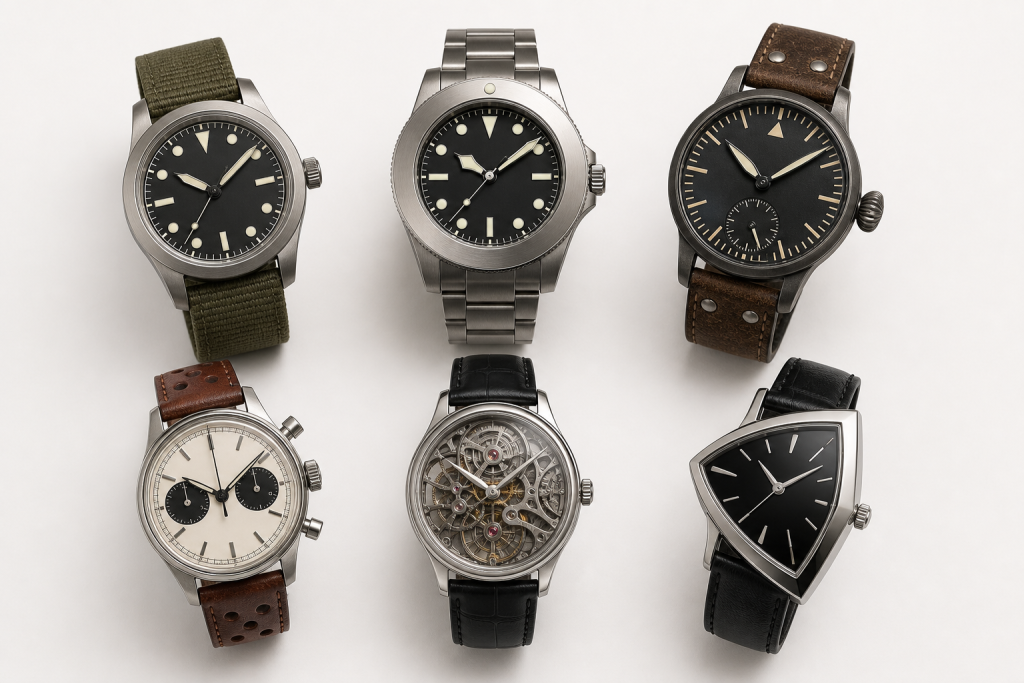
Hamilton watches are easiest to choose when the collection comes first: Khaki Field for military-inspired daily wear, Khaki Navy for water-focused sport, American Classic for heritage design, Jazzmaster for dressier contemporary styles, Ventura for an unconventional case shape, and Khaki Aviation for pilot-watch functions. Then compare the exact reference, dimensions, movement, condition, and seller documentation before paying.
Key takeaways
- Hamilton’s current catalog is organized around six collections, and the collection usually tells a buyer more about the watch’s intended character than the brand name alone.
- A 38 mm Khaki Field Mechanical is a compact hand-wound field watch with an 80-hour power reserve, while a 40 mm Khaki Navy Scuba Auto adds a screw-down crown, rotating bezel, and 100 m water resistance. (hamiltonwatch.com)
- The Khaki Field Murph 38 mm, Ventura Quartz, Jazzmaster Skeleton Auto, and American Classic Intra-Matic Auto Chrono serve very different style and wearing needs despite sharing the Hamilton name. (hamiltonwatch.com)
- Official U.S. prices are useful reference points, not marketplace values: selected current examples range from $675 for a Khaki Field Mechanical 38 mm to $2,595 for an Intra-Matic Auto Chrono. (hamiltonwatch.com)
- For a pre-owned Hamilton, confirm the reference, case dimensions, movement, included accessories, photographs, stated condition, and return terms before comparing asking prices.
Hamilton began in Lancaster, Pennsylvania, in 1892 as a maker of pocket watches. The modern brand combines that American history with Swiss production, and its catalog ranges from simple field watches to chronographs, dive-influenced watches, dress watches, and the unmistakably asymmetrical Ventura. (hamiltonwatch.com)
Which Hamilton collection fits the way you will wear it?

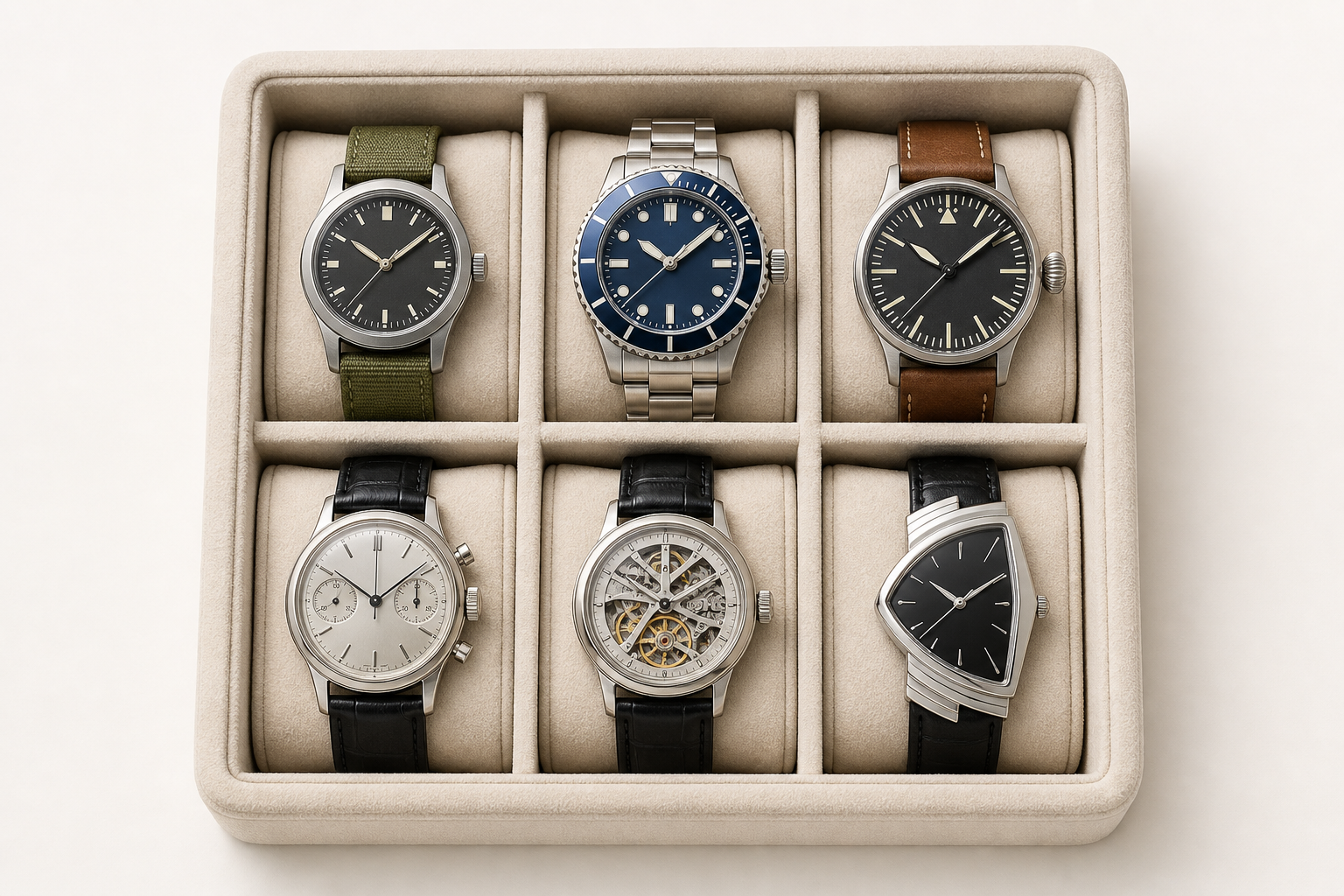
Start with the use case, not a single famous model. Hamilton’s official U.S. catalog currently groups its watches into American Classic, Jazzmaster, Khaki Aviation, Khaki Field, Khaki Navy, and Ventura, which gives buyers a practical first filter. (hamiltonwatch.com)
Khaki Field is the natural starting point for a legible, military-inspired everyday watch. The range includes hand-wound Mechanical models, automatic models, the film-connected Murph, and expedition-oriented versions. A Khaki Field Mechanical 38 mm, reference H69439931, has a 38 mm case, 9.5 mm thickness, sapphire crystal, 50 m water resistance, and Hamilton’s hand-wound H-50 caliber with an 80-hour reserve. (hamiltonwatch.com)
Khaki Navy is for a sportier watch with aquatic design cues. The current Scuba Auto 40 mm, reference H82425140, has 100 m water resistance, a screw-down crown, a unidirectional 60-minute bezel, and an H-10 automatic movement with an 80-hour power reserve. Those are useful specifications for swimming and general waterside wear, but a watch’s water-resistance rating is not a promise that an older, untested example remains equally water-resistant. (hamiltonwatch.com)
Khaki Aviation is the pilot-watch family. Expect larger cases, highly legible dials, day-date displays, and, on selected models, chronograph functions. The official catalog includes the 42 mm Khaki Aviation Pilot Day Date Auto and 40 mm Pilot Pioneer Mechanical Chrono variants. (hamiltonwatch.com)
American Classic contains Hamilton’s strongest heritage and vintage-inspired designs. The Intra-Matic line revisits late-1960s chronograph styling, while the current Cushion Mechanical brings a square-cushion case shape derived from a 1926 Hamilton design into smaller 30 mm and 34 mm formats. (hamiltonwatch.com)
Jazzmaster is the dressier modern collection. It is where buyers will find open-worked dials, skeletonized movements, and cleaner contemporary cases, including the 40 mm Jazzmaster Skeleton Auto. (hamiltonwatch.com)
Ventura is for someone who wants the case shape to be the point. The triangular Ventura was introduced by Hamilton in 1957 and remains the brand’s most immediately recognizable design direction; current quartz examples include a 32 mm by 50 mm version. (hamiltonwatch.com)
Choose the collection by the watch’s job and visual character before narrowing the reference, dial, and strap.
The quickest route to a suitable Hamilton is to choose the collection that matches your daily use, then compare references within that family.
What do the key Hamilton models offer?
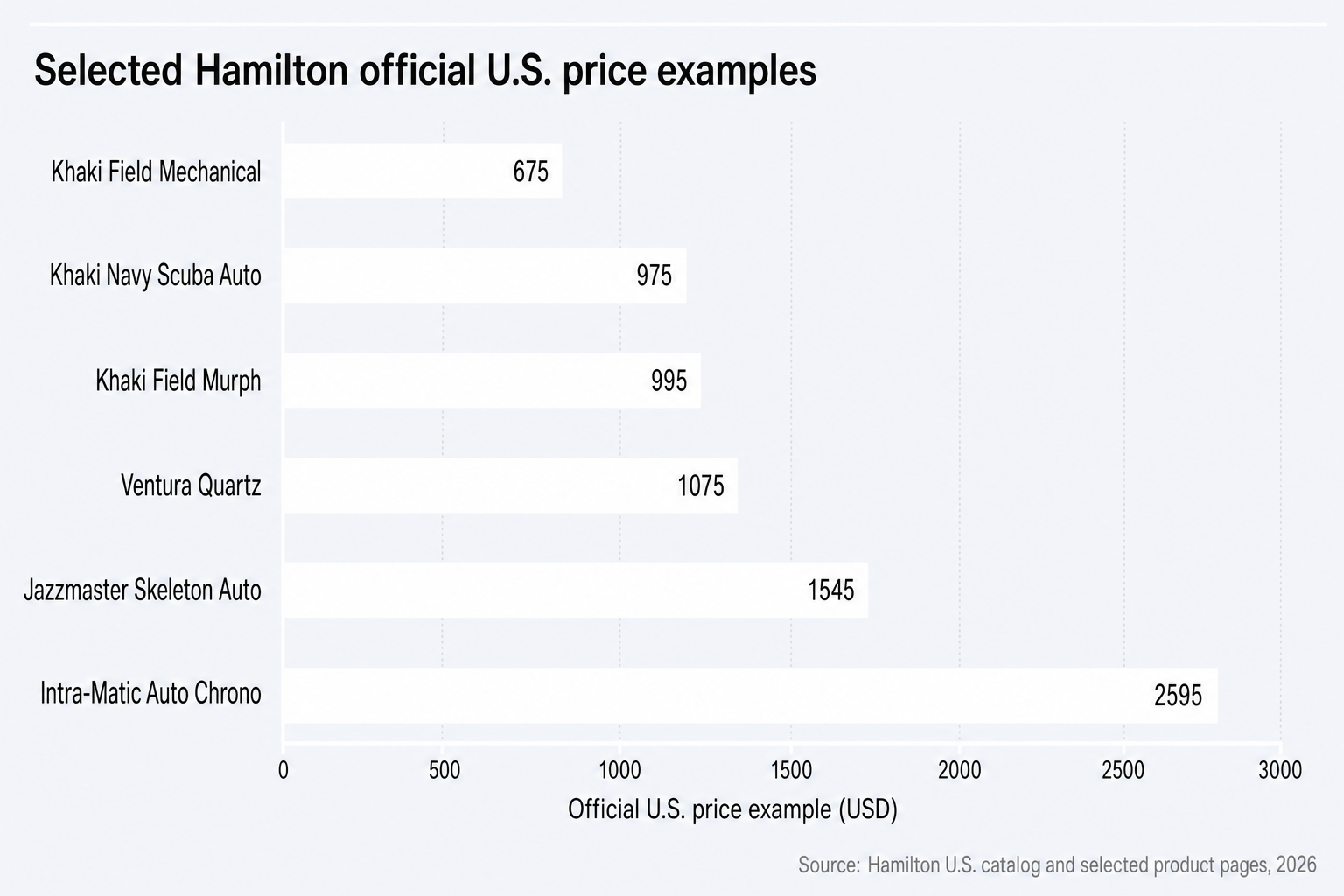
A few Hamilton references make the catalog easier to understand because they show how far the brand stretches, from a $675 manual-wind field watch to a $2,595 automatic chronograph in the current U.S. catalog. Prices and availability change by market, configuration, taxes, and seller, so use them only as dated reference points. (hamiltonwatch.com)
| Model example | What it is | Specifications worth checking | Official U.S. price shown |
|---|---|---|---|
| Khaki Field Mechanical 38 mm, H69439931 | Hand-wound field watch | 38 mm case, H-50 caliber, 80-hour reserve, 50 m water resistance | $675 |
| Khaki Field Murph 38 mm, H70405710 | Automatic field watch with film history | 38 mm case, H-10 automatic movement, cathedral hands | $995 |
| Khaki Navy Scuba Auto 40 mm, H82425140 | Automatic sport watch | 40 mm case, screw-down crown, 100 m water resistance, rotating bezel | $975 |
| Ventura Quartz | Asymmetrical quartz design | 32 mm by 50 mm case on the current U.S. catalog | $1,075 |
| Jazzmaster Skeleton Auto | Contemporary open-worked dress watch | 40 mm case on the current U.S. catalog | $1,545 |
| American Classic Intra-Matic Auto Chrono, H38416711 | Automatic heritage chronograph | 40 mm case, H-31 caliber, panda-dial styling | $2,595 |
The Khaki Field Mechanical is the most direct answer for a buyer who wants a stripped-back military-style watch and enjoys winding it. The Murph 38 is a more polished automatic alternative with a strong connection to Interstellar, while the Navy Scuba adds sport-watch hardware that changes how the watch works as well as how it looks. (hamiltonwatch.com)
The Intra-Matic Auto Chrono is the better fit for a buyer who specifically wants a mechanical chronograph and accepts a higher price, greater thickness, and more dial activity. Hamilton describes reference H38416711 as a contemporary reworking of a 1968 signature model, powered by its H-31 automatic movement. (hamiltonwatch.com)
The new American Classic Cushion Mechanical is worth isolating because it answers a different question: whether a compact, Art Deco-influenced manual-wind watch is more appealing than a round sports watch. The 30 mm square reference H36119520 uses Hamilton’s slim H-42 hand-wound caliber and has a 57-hour power reserve. (hamiltonwatch.com)
A named model matters less than whether its dimensions, movement, and condition fit the way you plan to wear it.
How should you choose between mechanical, automatic, and quartz?
Mechanical, automatic, and quartz watches do the same basic job but demand different ownership habits. A hand-wound mechanical watch asks for regular winding, an automatic watch winds through wrist motion, and a quartz watch uses a battery-driven electronic regulator.
Hamilton’s H-50 in the Khaki Field Mechanical is a hand-wound movement with an 80-hour stated power reserve. It suits buyers who want a simple three-hand watch and like the daily interaction of winding a crown. (hamiltonwatch.com)
Hamilton’s H-10 is a three-hand automatic movement used in watches such as the Khaki Navy Scuba Auto and selected Murph models. Hamilton states that the H-10 provides an 80-hour reserve, which is helpful if the watch is not worn every day, but an automatic watch still needs wrist movement or manual winding to build its reserve. (hamiltonwatch.com)
Quartz is the practical choice when precision, low fuss, and a thinner or more accessible watch matter more than mechanical tradition. Hamilton’s catalog includes quartz models across several collections, including Ventura, Khaki Field, American Classic, and Jazzmaster. (hamiltonwatch.com)
For a first mechanical Hamilton, choose the experience you want rather than treating one movement as universally superior. A hand-wound Khaki Field Mechanical is tactile and straightforward; an automatic Murph or Scuba Auto is more convenient for frequent wear; a quartz Ventura is the easiest way to prioritize the case design.
Movement choice is a lifestyle decision: pick manual winding for interaction, automatic for mechanical convenience, and quartz for minimum maintenance.
Which case size and water resistance should you actually buy?
Case diameter is only one part of fit, and water-resistance figures describe a watch’s rating when it leaves the factory, not a permanent guarantee. Check diameter, thickness, lug-to-lug length, strap or bracelet, and service history together before deciding that a Hamilton will wear small or large.
A 38 mm Khaki Field Mechanical has a 47 mm lug-to-lug length and is only 9.5 mm thick, which helps explain why it is often considered a compact field-watch format. The 40 mm Khaki Navy Scuba Auto is 13 mm thick, and its rotating bezel and screw-down crown give it a noticeably more substantial profile. (hamiltonwatch.com)
| Buying question | What to verify in the listing | Why it matters |
|---|---|---|
| Will it fit your wrist? | Diameter, lug-to-lug, thickness, and photographs on a wrist | Two 40 mm watches can wear very differently. |
| Is it for swimming or desk wear? | Water-resistance rating, crown type, service history, and pressure-test evidence if supplied | An older gasket system may not perform like a new watch. |
| Will you wear it daily? | Strap condition, bracelet links, clasp, crystal, and case wear | Replacement parts and refinishing can affect cost and originality. |
| Is it the exact version you want? | Reference number, dial, handset, case material, bracelet or strap, and box or papers | Small reference changes can alter specifications and desirability. |
A 50 m rating on the Khaki Field Mechanical and a 100 m rating with screw-down crown on the Scuba Auto are meaningful design differences, so do not buy a field watch expecting it to behave like a sport watch. (hamiltonwatch.com)
The numbers on a specification sheet are useful only when they are read together, especially for fit and water exposure.
How can you check a new or pre-owned Hamilton before paying?

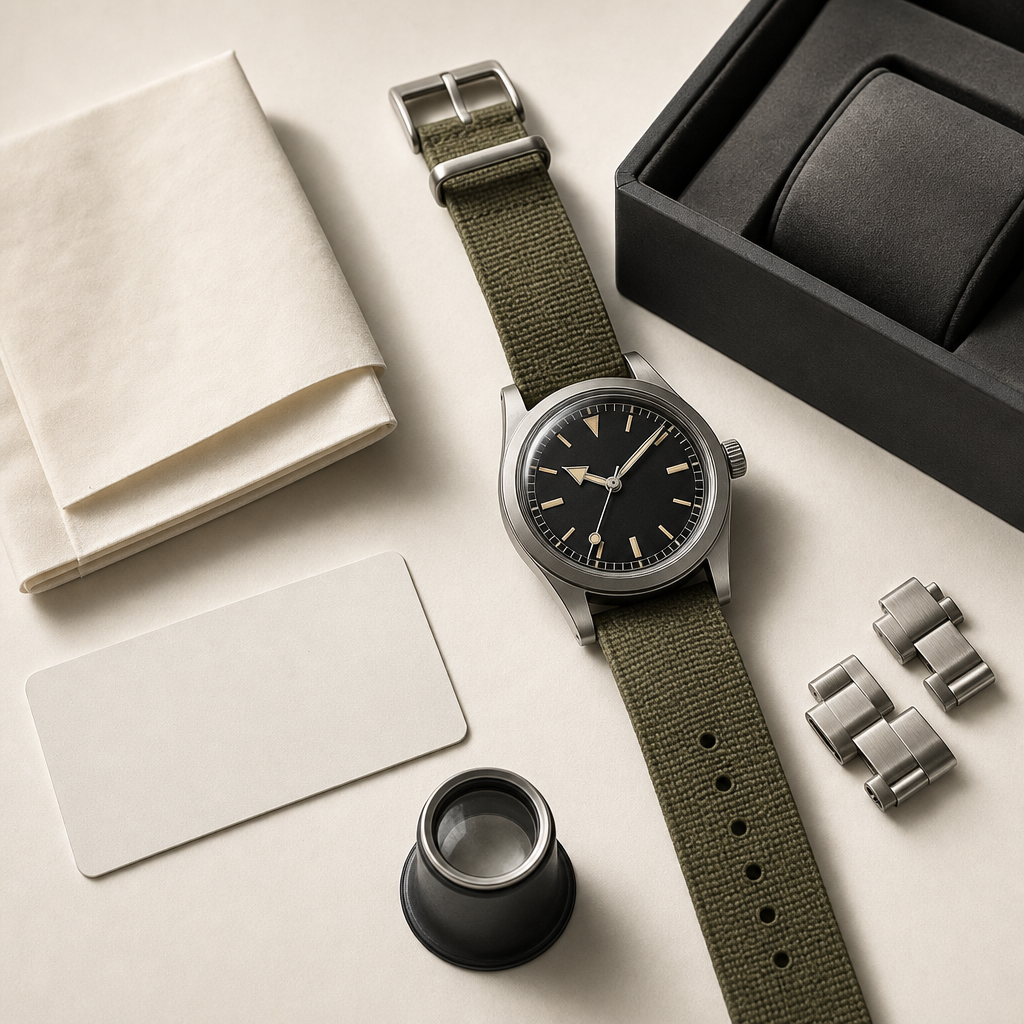
A careful listing review reduces avoidable surprises, but it cannot replace professional inspection when the condition, originality, or water resistance of a specific watch is uncertain. Ask for clear information first, then decide whether the seller’s answers and documentation justify the price.
Start by matching the seller’s reference number to an authoritative specification. A reference is more reliable than a collection name because Hamilton makes variations with different sizes, straps, movements, dial colors, and case treatments. Hamilton’s current product pages identify details such as caliber, case size, crystal, water resistance, and power reserve for each reference. (hamiltonwatch.com)
Then look for photographs of the dial, case sides, lugs, crown, caseback, clasp, bracelet, and crystal. For vintage or heavily worn pieces, ask whether parts such as hands, dial, crown, bracelet, or buckle have been replaced. A replacement part is not automatically a problem, but it should be described accurately and reflected in how you compare the listing.
For mechanical and automatic models, ask when the watch was last serviced and what work was performed. A seller may not know, and that uncertainty should be part of the buying decision. For any watch intended for water exposure, a recent pressure-test record is more useful than a decades-old factory rating.
Finally, check what is included: watch only, box, papers, spare links, extra straps, invoice, warranty card, or service receipt. These items do not create authenticity by themselves, but they can help a buyer understand the watch’s ownership history and compare one listing against another.
The safest comparison is not the lowest asking price; it is the listing with the clearest reference, condition disclosure, photographs, and transaction terms.
Where can you browse Hamilton watches and compare listings?
Browse by collection and reference first, then compare listings that disclose enough information to make a like-for-like decision. A marketplace search is most useful when it lets you filter by brand, collection, reference, case details, movement, functions, and water resistance rather than forcing you to compare title text alone.
Browse available watches on DreamChrono to search dealer listings and use model specifications as a starting point for comparing the stated reference, features, and condition. Availability changes, so a listing search should be treated as a live snapshot rather than a fixed catalog.
When several Hamilton listings look similar, make a short comparison note with the exact reference, price, location, condition description, included items, seller terms, and any missing information. That small amount of discipline is particularly useful with watches such as the Murph, Ventura, and Intra-Matic, where multiple sizes, dial colors, straps, and bracelet configurations can look similar at a glance.
A marketplace works best when you search the exact reference after deciding which collection and specifications fit your needs.
What else do buyers ask about Hamilton watches?
Hamilton sits between entry-level fashion watches and high-horology brands, which makes comparison questions common. The useful answer is usually not a universal ranking but whether a specific Hamilton reference matches the buyer’s budget, taste, wrist, and expectations for movement and finishing.
Is Hamilton watch a luxury brand?
Hamilton is commonly positioned as an accessible Swiss-made watch brand rather than a high-luxury manufacturer. Its current U.S. catalog includes watches from several hundred dollars into the low thousands, with examples such as the $675 Khaki Field Mechanical 38 mm and $2,595 Intra-Matic Auto Chrono. The brand’s value is its mix of history, distinctive designs, and mechanical options, not precious-metal exclusivity. (hamiltonwatch.com)
Are Hamilton watches Swiss Made?
Hamilton states that it combines American spirit with Swiss precision, and its current official retail pages describe its watches as Swiss Made. Hamilton was founded in Lancaster, Pennsylvania, in 1892, so the brand’s identity includes American history even though its modern watches are produced under Swiss watchmaking standards. (hamiltonwatch.com)
What is the best first Hamilton watch?
The best first Hamilton depends on what the buyer wants to wear most often. A Khaki Field Mechanical 38 mm suits someone who wants a compact hand-wound field watch; a Murph 38 mm is better for a versatile automatic with cinematic history; and a Ventura Quartz is the better choice when distinctive design and low-maintenance ownership matter most. (hamiltonwatch.com)
Are Hamilton watches good for everyday wear?
Many Hamilton watches are designed for regular wear, but the right model depends on activity. A Khaki Field Mechanical is a straightforward daily watch with 50 m water resistance, while a Khaki Navy Scuba Auto adds 100 m water resistance, a screw-down crown, and a rotating bezel. Check the exact reference because specifications differ within a collection. (hamiltonwatch.com)
The right Hamilton is the one whose reference, dimensions, movement, and condition you can verify before purchase. Choose the collection first, save the exact reference, and use the listing details to decide whether the specific watch is the right one.