
In short
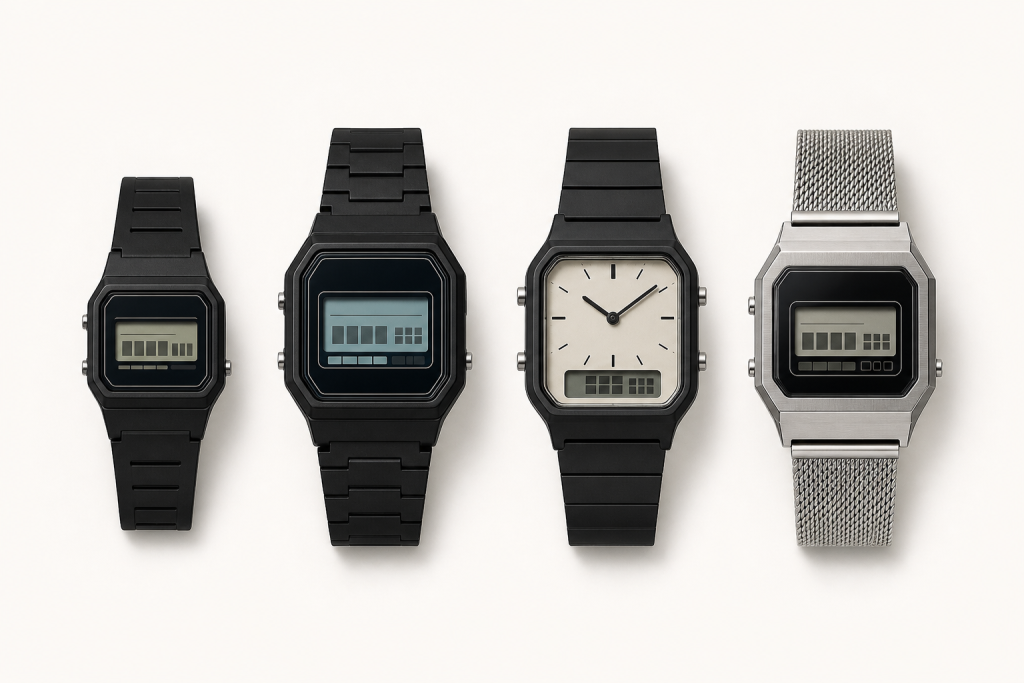
Casio Vintage watches are easiest to choose when you start with the display and case size, not the color. Pick a full digital model for a classic LCD look and practical timing functions, an analog-digital AQ-230 for a dressier face, or a premium-metal model if case material matters more than the lowest price.
- Casio Vintage is a current collection name, so a new Casio Vintage watch is not automatically an original watch from the 1970s, 1980s, or 1990s.
- The A168 is the practical full-digital choice, with an electro-luminescent backlight, alarm, stopwatch, and a 36.3 mm case width in Casio's specification.
- The AQ-230 is the analog-digital option, combining two hands with an LCD display in a slim 8.1 mm case.
- A basic Water Resistant marking is suitable for rain and hand washing, not swimming, unless the watch has a higher stated bar rating.
- Used listings deserve closer checks for bracelet stretch, plating wear, display condition, model reference, and battery history.
Contents
- Which Casio Vintage family fits your style?
- Which Casio Vintage watches work best for different wrist sizes?
- What should you compare before buying a Casio Vintage watch?
- Where can you compare Casio Vintage listings?
- Frequently asked questions about Casio Vintage watches
The useful distinction is not simply gold versus silver. Casio Vintage watches span compact digital pieces, wider digital cases, analog-digital designs, mesh bracelets, and higher-priced steel-cased options. Start by deciding how you want to read the time and how much visual presence you want on the wrist.
Which Casio Vintage family fits your style?

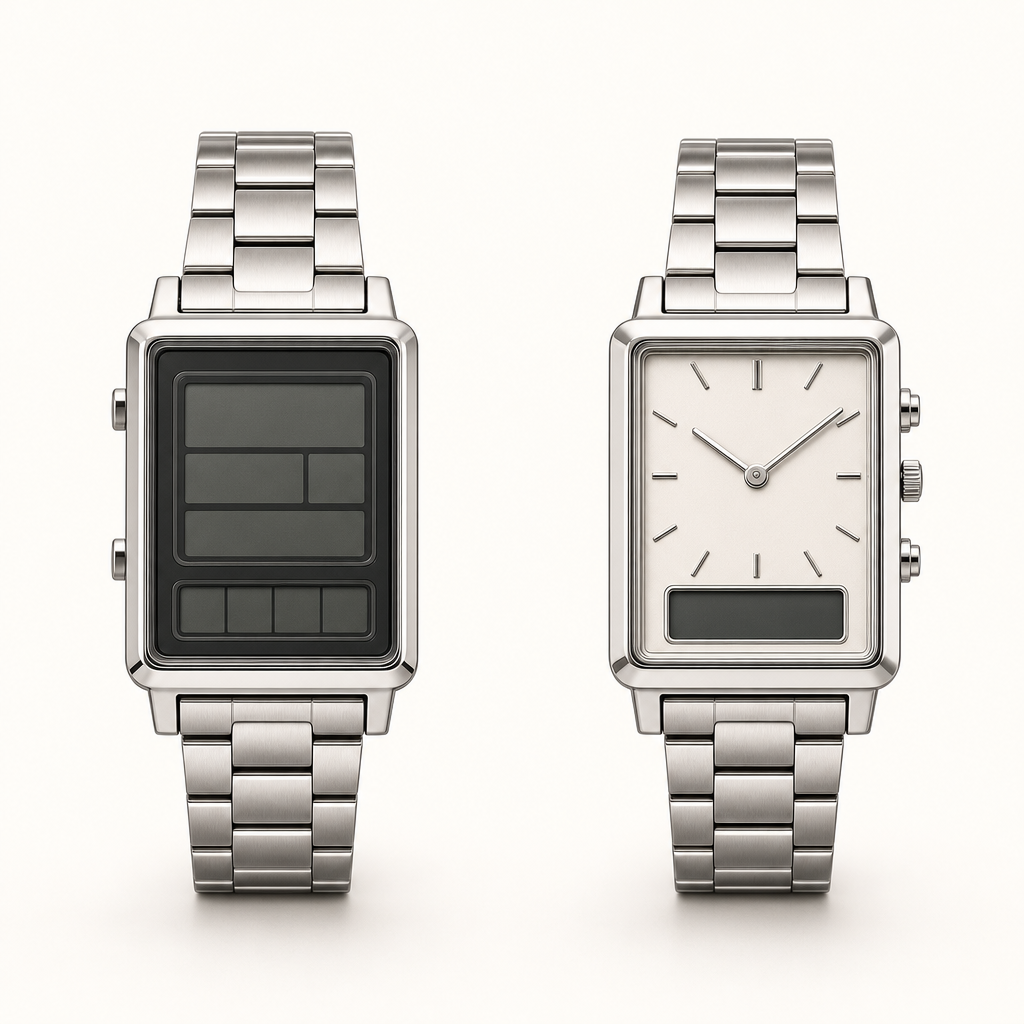
Choose a full digital model if the LCD display is the point of the watch. Choose an analog-digital model if you want hands, a more formal-looking dial, and a small digital readout for functions such as the date, alarm, or stopwatch.
Full digital: A158 and A168-style watches
The familiar rectangular LCD format is the direct route to the classic digital-watch look. It also gives the clearest access to everyday functions: time, date, day, alarm, stopwatch, and a light.
The A158WA-1 is a compact reference point. Casio specifies a 33.2 mm width, 8.2 mm thickness, chrome-plated resin case, stainless-steel bracelet, LED light, and an approximately seven-year battery life. The A168WA-1 is wider at 36.3 mm and 9.6 mm thick, and its defining feature is an electro-luminescent backlight that illuminates the display more evenly than a small point light. Casio's A158WA-1 specification and A168WA-1 specification provide the model-level details.
Choose the A158-style route when you want a smaller, flatter-looking digital watch. Choose the A168-style route when night readability and a slightly larger display matter more.
Analog-digital: AQ-230-style watches
The AQ-230 is for someone who likes the small rectangular case but does not want a purely digital face. Casio describes the line as an analog-digital design with two hands above an LCD display; the AQ-230 was introduced in 1995, while its 1982 AQ-200 predecessor was Casio's first combination model with hands and an LCD.
The current AQ-230A-7AVT specification lists a 29.8 mm case width, 8.1 mm thickness, chrome-plated resin case, stainless-steel bracelet, alarm, stopwatch, and basic water resistance. The narrow width creates a restrained, jewelry-like profile rather than the broader look of the A168. Casio's AQ-230 overview and AQ-230A-7AVT specification are the primary sources for those details.
Compact and mesh-bracelet: LA680-style watches
The LA680 family sits between compact and standard digital proportions. Casio lists the LA680WEM-7A at 28.6 mm wide and 8.6 mm thick, with a stainless-steel mesh bracelet, LED light, alarm, stopwatch, and a stated five-year battery life.
A mesh bracelet changes the character of a simple digital watch. It reads less like a utility strap and more like a small metal accessory, but it should still be inspected closely in a used listing for kinks, clasp wear, and missing adjustment hardware. Casio's LA680WEM-7A specification is a useful reference for the dimensions and functions.
Premium metal: A1000-style watches
The A1000 family is the material-led choice. On the A1000MA-7VT, Casio specifies a stainless-steel case and describes contrasting hairline and mirror finishes, plus a mesh bracelet. That is meaningfully different from the chrome-plated resin cases used on many entry-level Casio Vintage references.
A steel case does not make an A1000 a mechanical watch or a rare vintage collectible. It does mean the case construction and finishing deserve more attention when comparing listings. Casio's A1000MA-7VT product page identifies the material and finish.
The best Casio Vintage family is the one whose display and proportions suit daily wear, because bracelet color alone does not determine how a watch feels on the wrist.
Which Casio Vintage watches work best for different wrist sizes?
Case width is a useful first filter because Casio Vintage watches can look very different despite sharing a rectangular silhouette. A smaller case does not automatically mean a better fit, but it usually creates a quieter visual effect and leaves more bracelet visible.

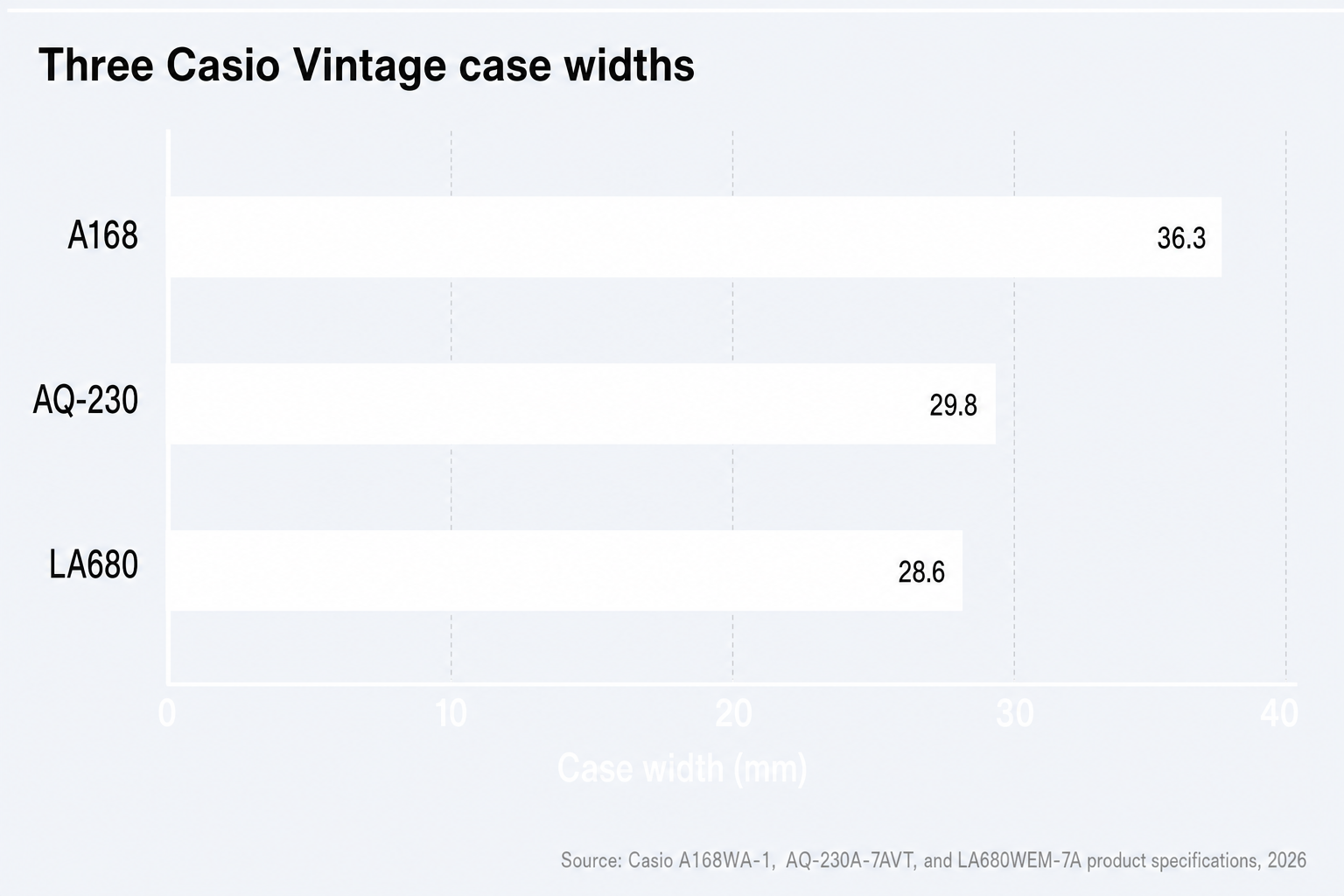
The A168's 36.3 mm width is the broadest of these three examples. It is still compact compared with many modern sport watches, but it has a visibly larger digital face than an AQ-230 or LA680. The AQ-230 is 29.8 mm wide, while the LA680 is 28.6 mm wide. Those measurements come from Casio's current product specifications.
For a small or slender wrist, begin with the AQ-230 or LA680 dimensions, then look at the lug-to-lug length in the listing photos. A rectangular case can appear longer than its width suggests. For a more assertive digital look, the A168's larger display and wider case are usually the safer starting point.
Do not rely on a seller's "men's" or "women's" label alone. Casio markets several of these formats as unisex, and wrist preference is more useful than a category label.
The most reliable sizing shortcut is to compare a listing's stated case dimensions with a watch you already wear comfortably, not with a generic gender label.
What should you compare before buying a Casio Vintage watch?
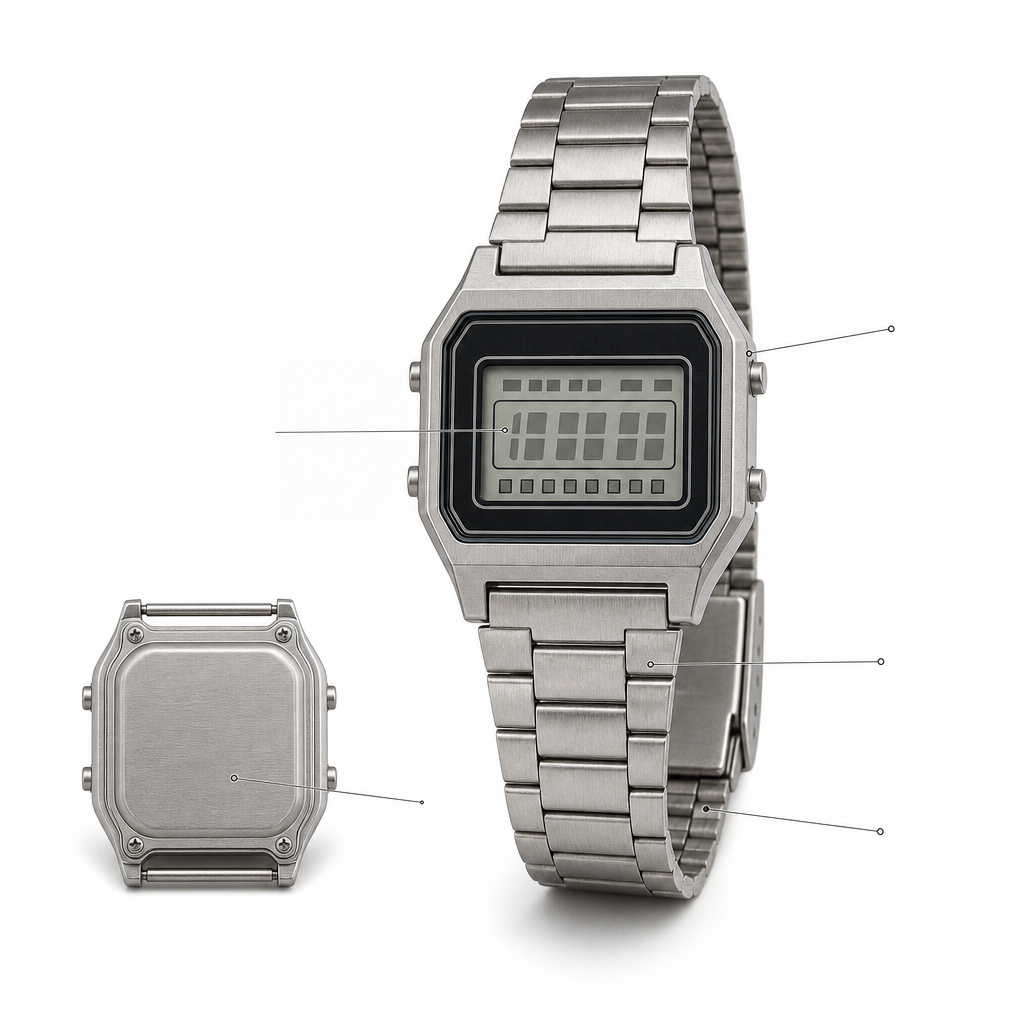
Compare the exact reference, case material, bracelet condition, display state, and water-resistance marking before comparing colorways. The goal is to identify what the watch actually is and what it can reasonably be expected to do, especially in a used listing.
Use this short checklist:
- Match the reference to the photos. A listing title can be incomplete. Check the dial layout, case shape, bracelet style, and case-back reference where shown.
- Separate resin with plating from steel. Chrome-plated resin and gold-tone finishes can show edge wear differently from solid stainless steel. Clear close-ups of corners, clasp, and bracelet links matter.
- Read the LCD. Look for missing segments, bleed, weak contrast, corrosion, or a display that only works in some modes.
- Ask about the battery and functions. Timekeeping alone does not confirm that the light, alarm, stopwatch, calendar buttons, and sounder work.
- Check bracelet length. Adjustable clasps help, but a bracelet should still be long enough for the intended wrist. Extra links are relevant on link bracelets, while mesh systems need their adjustment hardware intact.
- Treat water resistance precisely. Casio says watches marked only Water Resistant are appropriate for hand washing and rain, but not water-related work or swimming. A 5BAR, 10BAR, or 20BAR marking is a different rating, so read the marking rather than assuming all Casio Vintage watches have the same protection. Casio's water-resistance guidance explains the distinction.
A basic Water Resistant label is a daily-life rating, not a reason to wear a Casio Vintage watch for swimming.
Where can you compare Casio Vintage listings?
Compare listings only after you have narrowed the family and reference. Search filters are most useful when they let you combine brand, collection, reference, case material, movement type, functions, and water-resistance fields rather than forcing you to scan every gold- or silver-tone result.
A marketplace search should be a comparison tool, not a substitute for a model check. Open the product details, compare photos against the known reference features, and contact the seller directly when condition notes leave a material question unanswered.
Browse watch listings on DreamChrono Marketplace when you are ready to compare available watches by brand, collection, reference, case characteristics, movement, functions, and other stated specifications.
The right time to browse listings is after you can name the display type, approximate case size, material preference, and condition compromises you will accept.
Frequently asked questions about Casio Vintage watches
Are Casio Vintage watches actually vintage?
Casio Vintage is a current Casio collection name, so a new Casio Vintage watch is not necessarily an old watch from the 1970s, 1980s, or 1990s. Some designs have older roots, but buyers should use the model reference, production clues, condition, and seller description to distinguish current production from a genuinely older watch.
Which Casio Vintage watch is best for a small wrist?
An AQ-230 or LA680 is a sensible place to start for a small wrist because Casio lists them at 29.8 mm and 28.6 mm wide, respectively. Fit still depends on wrist shape, bracelet adjustment, and case length, so compare the published dimensions with a watch that already fits comfortably.
Are Casio Vintage watches waterproof?
Casio Vintage watches are generally described as water resistant, not waterproof, and the exact rating varies by model. Casio states that a watch marked only Water Resistant can handle rain and hand washing but is not intended for swimming. Check the dial, case back, or specification for a stated bar rating before water exposure.
What should I check before buying a used Casio Vintage watch?
Before buying a used Casio Vintage watch, confirm the reference, inspect the case corners and bracelet, verify that every LCD segment appears, and ask whether the light, alarm, buttons, and stopwatch work. Also check bracelet length and read the water-resistance marking instead of assuming a vintage-looking digital watch is swim-ready.
What should you do next?
Choose the family first: compact digital, larger digital, analog-digital, or premium metal. Then compare only the listings that match that choice, and give condition details the same weight as the color of the bracelet.