
In short
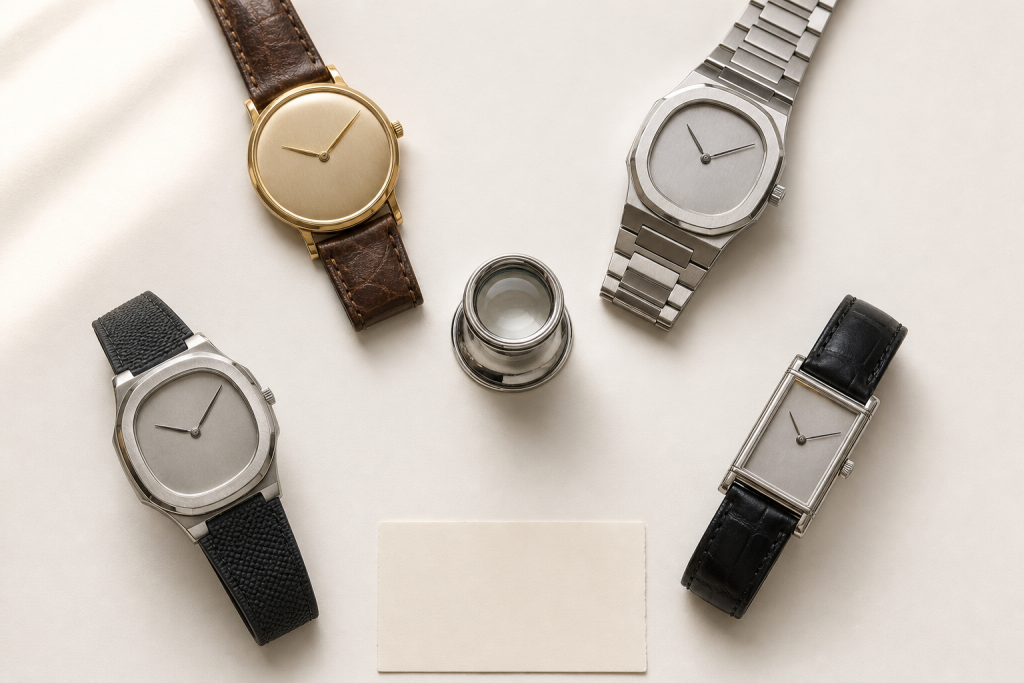
Pre-owned Patek Philippe watches are easiest to compare when the search follows four steps: choose the collection that fits how the watch will be worn, identify the exact reference and configuration, assess the individual watch's condition and history, then compare dealer terms side by side. A collection name alone is not enough to make a buying decision.
- A Calatrava, Nautilus, Aquanaut, Twenty~4, or complicated Patek Philippe can suit very different wearing habits, even when two watches appear close in price.
- A reference number identifies a model configuration; the exact watch still needs its own condition report, images, scope of delivery, and service discussion.
- Original papers and an Extract from the Archives are useful records, but neither removes the need to compare the physical watch and the dealer's documentation carefully.
- Patek Philippe states that eligible watches must have been first sold at least 10 years before an Extract from the Archives can be requested.
- DreamChrono lets buyers search dealer listings by brand, collection, reference, and technical attributes, but buyers should still clarify condition, documentation, payment, shipping, and return terms directly with the dealer.
Table of contents
- Which pre-owned Patek Philippe collection suits the way you will wear it?
- Which reference details should you compare before looking at price?
- How should you read a professional dealer listing?
- What do box, papers, and service history actually tell you?
- How should condition change your decision?
- How can you compare two Patek Philippe listings without missing the costly details?
- Frequently asked questions about pre-owned Patek Philippe watches
- What should you do before contacting a dealer?
Which pre-owned Patek Philippe collection suits the way you will wear it?

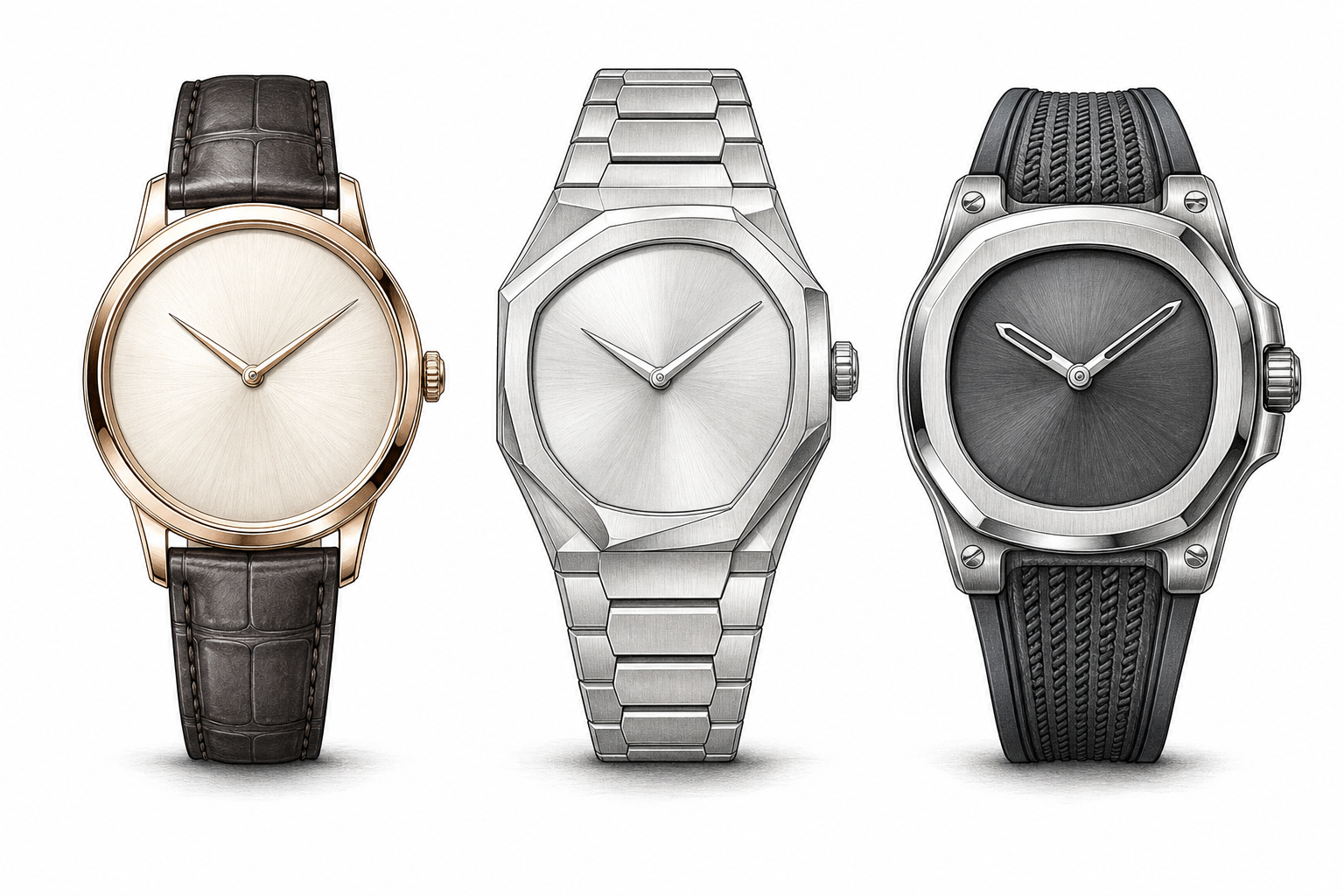
Choose the collection before comparing individual listings. The right collection is the one whose case shape, movement type, complications, bracelet or strap, and intended use still make sense after the first excitement of finding a particular reference.
Patek Philippe's current collection groups watches into families including Calatrava, Nautilus, Aquanaut, Complications, Grand Complications, Twenty~4, Gondolo, Golden Ellipse, and Cubitus. The secondary market is broader because discontinued references sit alongside current designs. Patek Philippe's collection overview is a useful starting point for seeing how the manufacturer separates those families. (patek.com)
Calatrava: the classic round watch
The Calatrava is the most direct starting point for a buyer who wants a formal or versatile round watch rather than an overtly sporty design. Patek Philippe dates the first Calatrava, Ref. 96, to 1932 and describes the collection as its quintessential round wristwatch. Modern and older examples range from simple time-only watches to calendar and travel-time variants, so a buyer should not assume that every Calatrava is small, manual-wind, or minimalist. Patek Philippe's Calatrava collection page provides the official design context. (patek.com)
Look first at diameter, metal, dial layout, and whether the watch is time-only or complicated. Those details affect how the watch wears and how costly future servicing may be.
Nautilus: integrated-bracelet sporting elegance
The Nautilus suits a buyer who wants a recognizable integrated-bracelet sports watch with a more formal finish than a conventional tool watch. Patek Philippe says the Nautilus launched in 1976 and identifies its rounded octagonal bezel, porthole-inspired case, and horizontally embossed dial as the defining visual features. The family includes more than simple date models, with examples incorporating annual calendars, perpetual calendars, moon phases, chronographs, and Travel Time functions. Patek Philippe's Nautilus collection page confirms the breadth of the range. (patek.com)
For pre-owned buyers, bracelet condition and the exact configuration deserve unusual attention. A listing title that simply says "Nautilus" leaves out the reference, metal, dial, complication, bracelet completeness, and degree of prior refinishing that can separate two apparently similar watches.
Aquanaut: a sportier profile with a composite strap
The Aquanaut is the more casual sports-watch route, especially for buyers who prefer a composite strap and a more relaxed visual language. Patek Philippe says the Aquanaut debuted in 1997 and uses the same embossed pattern across the dial and strap; the current family also includes Travel Time, chronograph, annual calendar, and jeweled models. Patek Philippe's Aquanaut collection page details those design codes. (patek.com)
A strap-equipped Aquanaut can be easier to wear day to day, but the listing should still identify the original strap and clasp arrangement, spare straps if included, and the condition of the case edges and bezel. A replacement strap may be practical, but it is not the same thing as an original full set.
Complications and Grand Complications: buy the function, not the label
A complication is a mechanical function beyond basic time display. Patek Philippe's Complications collection includes practical functions such as annual calendars, chronographs, dual-time displays, and World Time displays, while Grand Complications occupy a more technically demanding part of the range. Patek Philippe's official Complications overview explains the manufacturer's categories. (patek.com)
A useful complication is worth more to the owner than an impressive complication that is never used. Calendar settings, corrector tools, operating instructions, recent service evidence, and the ability to explain the watch's functions should all be part of the buying conversation.
Twenty~4 and other shaped or jewelry-led options
The Twenty~4 deserves consideration for buyers seeking a rectangular cuff-style watch or a round automatic model with a more jewelry-oriented presentation. Patek Philippe introduced the original Twenty~4 in 1999 and currently distinguishes quartz cuff-style examples from round self-winding versions. Patek Philippe's Twenty~4 collection page sets out the two case formats. (patek.com)
Do not treat pre-owned Patek Philippe watches as divided neatly into men's and women's categories. Case dimensions, lug-to-lug fit, bracelet length, dial design, and personal preference are more useful filters than a label attached to a listing.
The collection should explain why you want the watch before a reference number narrows the search.
Which reference details should you compare before looking at price?

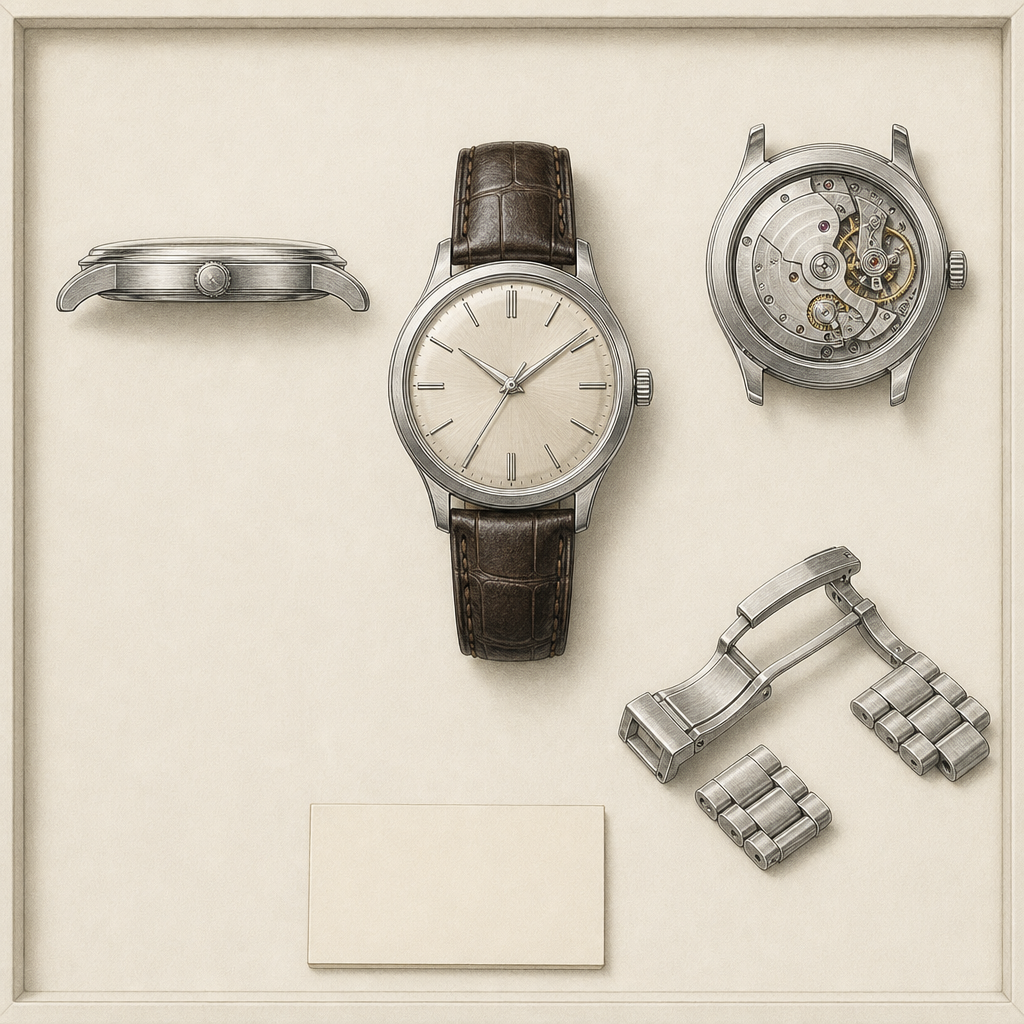
A reference number identifies a specific model configuration, not the condition or completeness of the exact watch for sale. Compare the reference first so that the price comparison is between like-for-like watches rather than between different metals, dials, movements, or complications.
A collection label tells you the family. A reference tells you far more, such as the case material, intended movement, dial arrangement, bracelet or strap format, and complication set. A suffix can also matter, because it may distinguish a dial, metal, bracelet, or market configuration.
Start every shortlist with these fields:
- Full reference: Record every character shown in the listing and ask the dealer to confirm it against the watch and accompanying documentation.
- Case and bracelet or strap: Note the material, dimensions, clasp type, bracelet length, and whether all removed links are included.
- Dial and hands: Check the exact color, indexes, numerals, gemstones, and whether the listing states that the dial and hands are original to the watch.
- Movement and functions: Confirm the caliber where provided and list every function that needs to operate correctly, such as calendar displays, chronograph controls, or a second time zone.
- Production era or sale date: A reference may have a long run. The individual watch's era can affect dial details, paperwork, service requirements, and collector interest.
- Scope of delivery: Separate the watch itself from its box, Certificate of Origin, manuals, service invoice, additional strap, setting pin, corrector, and other accessories.
Keep the reference number separate from the serial number. Patek Philippe says that the original Certificate of Origin identifies a new watch through its movement, case, and reference numbers. The company also says that it does not issue replacement copies of the original Certificate of Origin. Its Extract from the Archives FAQ explains the distinction. (patek.com)
A reference number makes a comparison possible; the exact watch's condition and scope of delivery determine whether the comparison is fair.
How should you read a professional dealer listing?

A strong dealer listing lets a buyer identify the precise watch, understand what is included, and know which questions remain unanswered. A polished product description is useful, but the decision should rest on specific fields, clear photographs, and terms that can be confirmed before payment.
DreamChrono's Buy Watches marketplace is designed for searching watch listings by attributes such as brand, collection, reference, case characteristics, movement, functions, and water resistance. Use those filters to form a narrow shortlist, then compare the details of individual dealer listings instead of relying on a broad search result.
Read a listing in this order:
- Identity: Is the full reference stated, and do the photographs appear consistent with that reference?
- Watch-specific condition: Does the dealer describe the case, bezel, bracelet or strap, dial, hands, crystal, and movement separately?
- Photographic evidence: Are there clear front, side, caseback, clasp, bracelet, and close-up images, rather than only one polished studio image?
- Included items: Does the listing specify box, original papers, manuals, service records, extra links, straps, and tools?
- Seller terms: Are shipping destinations, taxes or duties, payment process, returns, warranty terms, and delivery timing stated or available on request?
- Dealer communication: Can the dealer answer reference-level questions plainly and provide additional photographs where reasonable?
Do not infer a platform-operated authentication service, condition test, escrow arrangement, or buyer-protection program from the presence of a marketplace listing. DreamChrono provides dealer listing infrastructure and direct dealer communication; buyers should establish the dealer's own sales terms and satisfy themselves about the watch before completing a purchase.
A professional listing is not just a price and a photograph; it is a set of precise facts that can be compared and clarified.
What do box, papers, and service history actually tell you?
Box, papers, and service records can make a watch easier to document, but they should be considered alongside the watch itself. They help establish a chain of information, yet they do not replace a careful review of the exact reference, visible condition, and dealer disclosures.
Patek Philippe distinguishes between the Certificate of Origin supplied with a new watch and an Extract from the Archives. The Certificate of Origin identifies the movement, case, and reference numbers. An Extract from the Archives is a partial transcript from the manufacturer's archive records, describing key features and the date of sale for a qualifying watch. (patek.com)
As of November 2026, Patek Philippe says an Extract can be requested only for a timepiece first sold at least 10 years before the request. The company lists a fee of CHF 500 and says confirmed requests are sent within 10 weeks. It also requires photographs so that the watch can be checked visually against the archive description. Patek Philippe's ordering page gives the current terms. (patek.com)
That makes an Extract potentially valuable for an older watch, but not an instant solution for a purchase that needs to close this week. Ask the dealer what documentation is already present, what can be supplied before the sale, and which details the documents support.
Service history deserves equal attention. Patek Philippe's current Watch Care Recommendations say mechanical and quartz watches should generally be serviced every eight to 10 years through an official service center or authorized retailer, while the right schedule can vary with use and the model's instructions. Patek Philippe's watch care guidance is the relevant primary source. (patek.com)
Ask for the date, provider, scope, and invoice for any stated service. A recent invoice may be helpful, but words such as "serviced" or "checked" are not enough without knowing what work was actually performed.
Documentation is strongest when it matches the reference, the physical watch, and a clear service record.
How should condition change your decision?
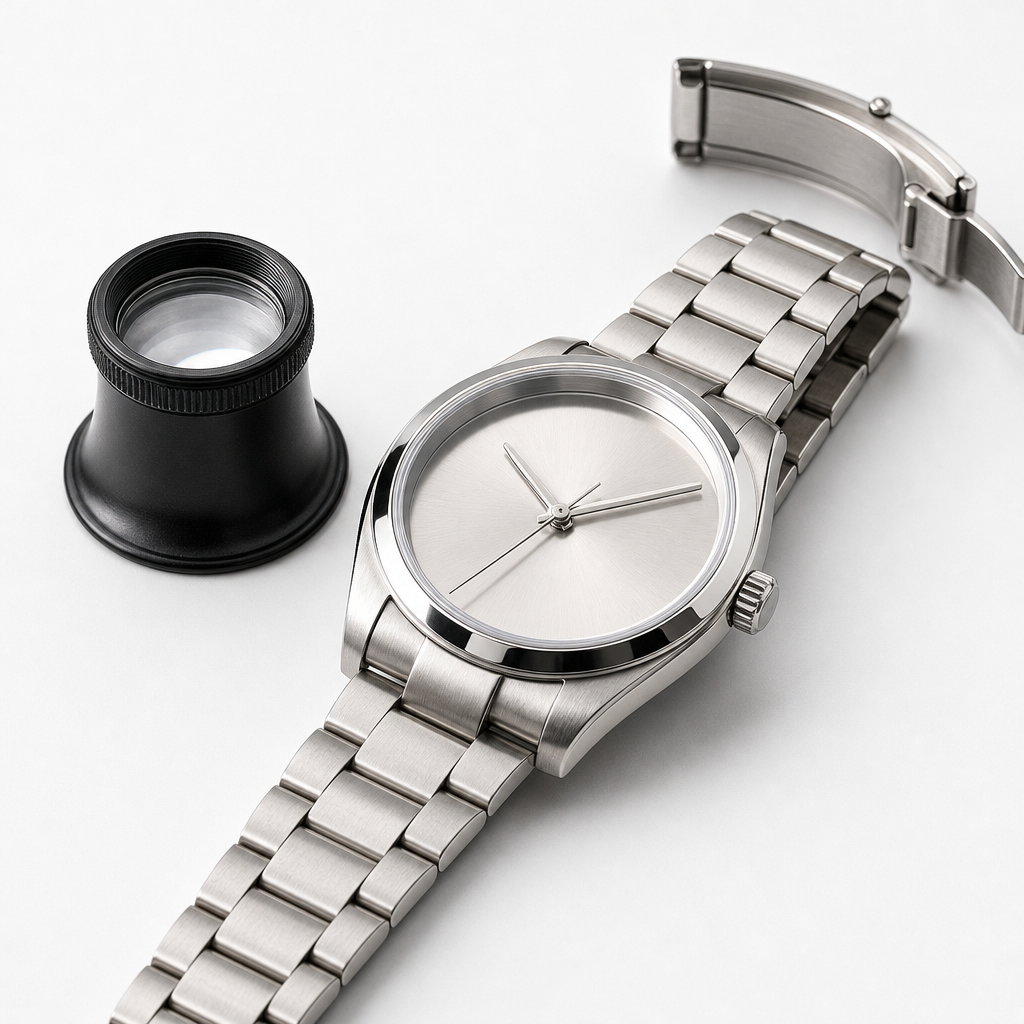
Condition should change both the amount you are willing to pay and the questions you ask. A clean-looking watch can still have softened case edges, polished surfaces, missing bracelet material, altered components, or deferred service needs that only become clear in close photographs and careful answers.
Focus on the parts most likely to affect originality, wearability, and future cost:
- Case geometry: Crisp bevels, consistent brushing, and intact edges matter. Heavy polishing can change the original shape.
- Bezel and crystal: Ask about chips, impacts, scratches, and replacement history.
- Bracelet: Confirm stretch, clasp function, link count, and whether spare links are present. Bracelet sizing can be expensive to solve after the purchase.
- Dial and hands: Request high-resolution images under direct light and ask about discoloration, marks, relume work, or replacements.
- Movement performance: Ask who assessed the movement, when it was last serviced, and whether every complication has been tested.
- Water resistance: Treat a vintage or pre-owned water-resistance claim as a current maintenance question, not as a permanent property. Ask when it was last tested and what use the dealer considers appropriate.
Condition is not simply good or bad. A watch may be honest but visibly worn, restored but mechanically sound, or visually sharp with unclear service history. The point is to understand the trade-off before treating one listing as cheaper than another.
Condition is a buying variable, not a footnote, because the same reference can be a different proposition in a different state of preservation.
How can you compare two Patek Philippe listings without missing the costly details?
Compare two listings in a single table before contacting either dealer. A side-by-side view prevents price from becoming the only memorable difference and exposes the missing information that should shape the next question.
| Comparison field | Listing A | Listing B | Why it matters |
|---|---|---|---|
| Full reference | Confirms that the comparison starts with the same model configuration. | ||
| Case metal and dimensions | Metal and size can make similar-looking references materially different. | ||
| Dial, hands, and bezel | Originality and condition are often visible in these components. | ||
| Bracelet or strap scope | Link count, clasp condition, and original accessories affect fit and completeness. | ||
| Movement and complications | More functions require more specific operational checks and service questions. | ||
| Condition disclosure | Separate case, bracelet, dial, crystal, and movement comments are more useful than one grade. | ||
| Box, papers, and service records | Documents should be matched to the exact watch and reference. | ||
| Dealer terms | Shipping, taxes, returns, warranty, and payment terms affect the final decision. | ||
| Questions still open | Missing information is a reason to pause, not to guess. |
The best use of a comparison table is not to find a winner immediately. It is to create a short, consistent list of questions for both dealers. If one dealer can answer reference, condition, and documentation questions clearly while another cannot, that difference belongs in the decision even if the asking prices are close.
A lower price is only meaningful after the two listings have been normalized for reference, condition, completeness, and dealer terms.
Frequently asked questions about pre-owned Patek Philippe watches
How much should I pay for a pre-owned Patek Philippe?
The right price for a pre-owned Patek Philippe depends on the exact reference, metal, dial, complication, condition, documentation, service status, completeness, and dealer terms. Compare listings only after confirming that they represent the same configuration. A low asking price may reflect missing papers, a worn bracelet, unclear history, or different tax and shipping terms.
Do I need box and papers to buy a used Patek Philippe?
Box and papers are not mandatory for every pre-owned Patek Philippe purchase, but they should be priced and documented honestly. Original papers can help connect the watch to its stated numbers and sale history. Buyers should still compare the physical watch, the reference, condition photographs, and service evidence rather than treating paperwork as a complete substitute for due diligence.
Is an Extract from the Archives the same as original papers?
No. Patek Philippe describes an Extract from the Archives as a partial transcript from its archive records, while the Certificate of Origin is the original document delivered with a new watch. As of November 2026, an Extract can be requested only for watches first sold at least 10 years earlier and is not a replacement Certificate of Origin. (patek.com)
What should I ask a dealer before buying a pre-owned Patek Philippe?
Ask for the full reference, clear images of the actual watch, a component-by-component condition description, included items, service documentation, bracelet or strap details, and the dealer's shipping, payment, return, and warranty terms. If the watch has complications, ask how each function was checked. Ask the same questions of every dealer so the answers can be compared fairly.
What should you do before contacting a dealer?
Start with one collection, narrow the search to a reference or a very small set of references, then use the comparison table to identify the facts each listing must provide. Contact a dealer only after the open questions are written down, because precise questions produce more useful answers than a general request for the best price.
Browse current Patek Philippe dealer listings on DreamChrono when you are ready to search by collection, reference, and watch specifications. Keep the shortlist small, compare the exact watches rather than their collection names, and pause whenever the condition, documentation, or terms remain unclear.
The most useful buying habit is simple: compare the actual watch, not the headline.