In short
Rolex Day-Date buyers should choose the size first, then the reference generation, metal, dial and condition. The current collection offers 36 mm and 40 mm cases, while pre-owned searches add the 41 mm Day-Date II and several 36 mm generations. Search listings by complete reference, not by “President” alone.
Key takeaways
- The current Day-Date 36 and Day-Date 40 use calibre 3255, with approximately 70 hours of power reserve and water resistance to 100 metres. Rolex publishes the shared technical specifications. (newsroom.rolex.com)
- Selected Rolex U.S. catalog prices checked September 11, 2026 included $45,900 for a yellow-gold Day-Date 36 and $50,400 for a yellow-gold Day-Date 40; each price belongs to a specific configuration. See the current Day-Date catalog. (rolex.com)
- Rolex's general collection overview still describes yellow, white and Everose gold plus platinum, while the specific 2026 release adds Jubilee Gold on Day-Date 40 reference 228235JG. Rolex introduced the new alloy in 2026. (newsroom.rolex.com)
- Reference 18038 provides a quick-set date, while the 18238 and 118238 generations provide double quick-set day and date adjustment; the older 1803 requires slow calendar setting. Sotheby's maps the principal generations. (sothebys.com)
- DreamChrono displayed 24 marketplace watches from three stores on September 11, 2026, but no Rolex brand facet or Day-Date listing was visible. Availability should be checked rather than assumed. (dreamchrono.com)
Contents
- Which Rolex Day-Date should you shortlist first?
- Should you choose a Day-Date 36, Day-Date 40 or Day-Date II?
- Which Rolex Day-Date reference families matter when shopping?
- Which metal, dial and bracelet combination makes sense?
- What specifications do current Day-Date models share?
- How much does a Rolex Day-Date cost in 2026?
- What should you check before buying a pre-owned Day-Date?
- Are any Rolex Day-Date watches available on DreamChrono now?
- What else do buyers ask about the Rolex Day-Date?
- What should you do next?
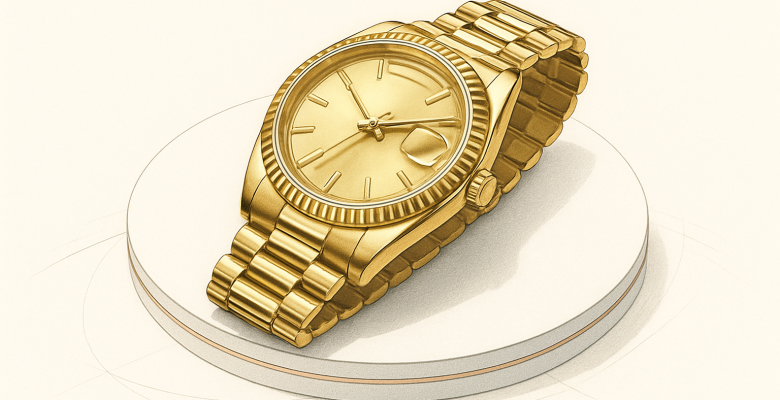
A Day-Date search can place a circa-1970 reference 1803 beside a current 128238 and a discontinued 41 mm 218238. The watches share the full day display at 12 o'clock and date at 3 o'clock, but they do not share the same crystal, movement, calendar-setting method, case size or ownership demands.
Which Rolex Day-Date should you shortlist first?
Start with the current Day-Date 36 if classic proportions matter most, the current Day-Date 40 if greater wrist presence is the priority, or a pre-owned Day-Date II if 41 mm is a firm requirement. Then narrow the search by metal and complete reference before choosing a dial.
Four practical starting points cover most searches:
- Current and classically sized: Begin with reference 128238 in yellow gold, 128239 in white gold, 128235 in Everose gold or 128236 in platinum.
- Current and larger: Begin with the equivalent 40 mm families, including 228238, 228239, 228235 and 228236.
- Largest mainstream Day-Date: Look for the discontinued 41 mm Day-Date II, including references such as 218238.
- Vintage or neo-vintage: Compare the 1803, 18038, 18238 and 118238 generations according to crystal, calendar setting, condition and bracelet completeness.
Dial color should come after this decision. A blue, black, champagne, ombré, stone or diamond-set dial can change the appearance and price, but it does not correct a case that feels too large or a slow-set movement that becomes frustrating in occasional rotation.
Rolex launched the collection in 1956. The manufacturer's current timeline records the 41 mm Day-Date II in 2008, the 40 mm Day-Date with calibre 3255 in 2015 and the Jubilee Gold Day-Date 40 in 2026. Rolex's Day-Date timeline provides those milestones. (rolex.com)
Choose the case family before the dial, because size and generation determine the watch you will live with.
Should you choose a Day-Date 36, Day-Date 40 or Day-Date II?
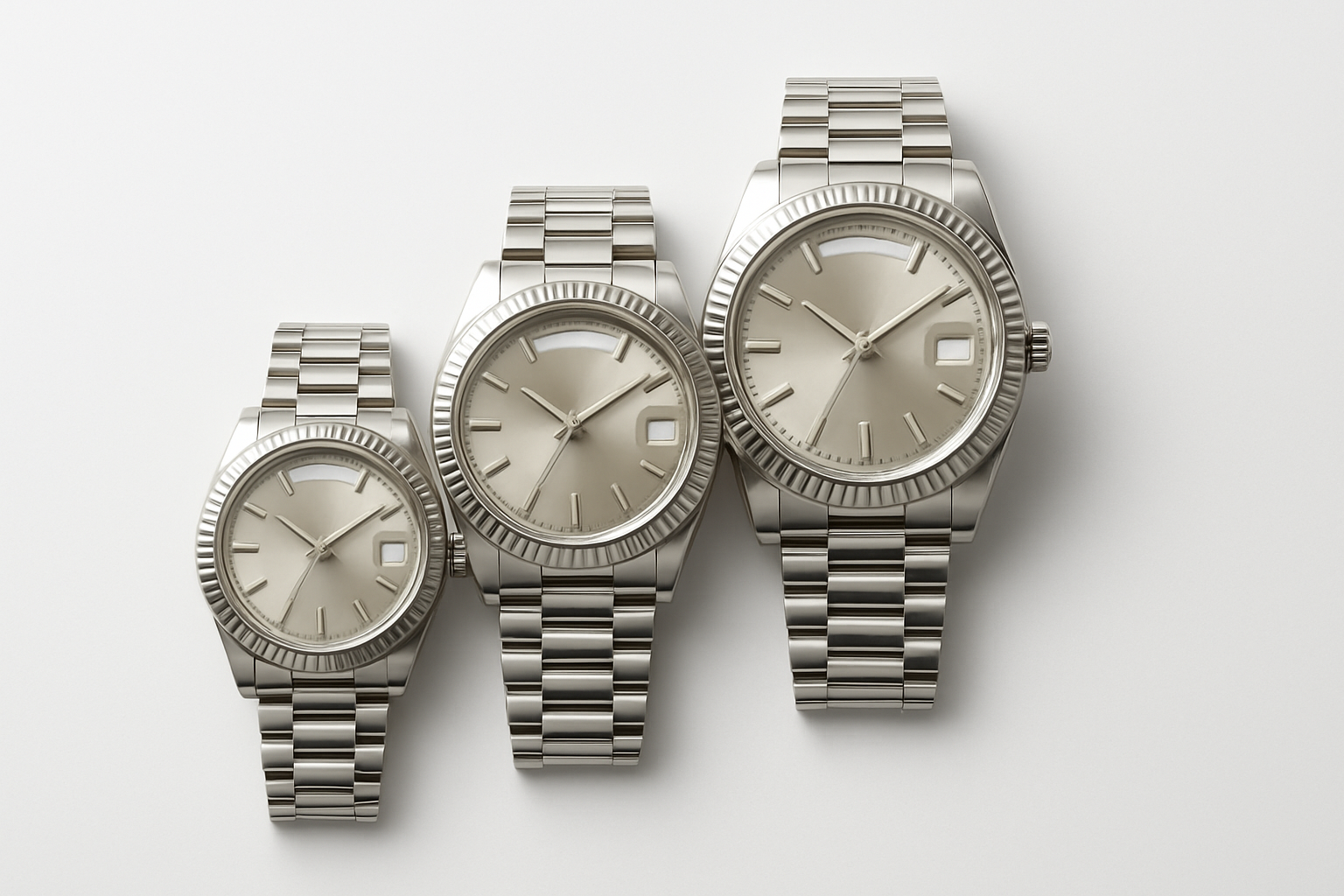
The Day-Date 36 provides the broadest historical choice and remains a current model, while the Day-Date 40 provides the larger option in the present catalog. The 41 mm Day-Date II is discontinued and belongs to a distinct 2008 generation with calibre 3156. (rolex.com)
Choose 36 mm for proportion and reference depth. The 36 mm case is the link between early Day-Dates, the long-running 1803 family, five-digit and six-digit generations, and today's 128-series watches. It can still feel substantial because the case and bracelet are precious metal, but its diameter preserves the collection's traditional balance.
Choose 40 mm for current specifications with more presence. The Day-Date 40 is not merely an enlarged 36. The greater dial area, broader bracelet and surrounding metal give colored, ombré and stone dials more visual force. It uses the same current calibre 3255 as the Day-Date 36.
Choose 41 mm only if that specific shape appeals. Rolex introduced the Day-Date II and calibre 3156 in 2008, then replaced the large-case concept with the more restrained 40 mm model in 2015. The Day-Date II's proportions, including its wider-looking bezel, make it visually distinct from both current sizes. (rolex.com)
Diameter is only a starting measurement. Bracelet fit, wrist shape and the position of the first links affect how much surface the watch occupies, so a try-on is more reliable than comparing numbers in isolation.
The 36 mm is the classic choice, the 40 mm is the current larger choice, and the 41 mm Day-Date II is the discontinued maximum.
Which Rolex Day-Date reference families matter when shopping?
The most useful Day-Date references mark changes in crystal, movement, calendar adjustment or case diameter. A complete reference is therefore more informative than a listing that says only Rolex President or gold Day-Date.
| Reference family | Case | Defining feature | Buying consequence |
|---|---|---|---|
| 6510, 6511 and 6611 | 36 mm | Early launch-era Day-Dates | Rare specialist purchases with early movements and fewer comparable examples |
| 1803, circa 1960 to 1978 | 36 mm | Acrylic crystal, calibres 1555 or 1556, slow-set calendar | Strong vintage character, but setting the calendar takes more time |
| 18038, 1977 to about 1988 | 36 mm | Sapphire crystal, calibre 3055, quick-set date | Easier date correction, while the day still requires cycling |
| 18238, 1988 to about 2000 | 36 mm | Calibre 3155 and double quick-set calendar | Day and date can be adjusted independently |
| 118238, circa-2000 generation | 36 mm | Six-digit reference with calibre 3155 | A more modern case and bracelet era with the traditional diameter |
| 218238 and related Day-Date II references | 41 mm | Launched in 2008 with calibre 3156 | The largest mainstream Day-Date generation, now discontinued |
| 228238, 228239, 228235 and 228236 | 40 mm | Current family with calibre 3255 | Current larger case, 70-hour power reserve and secure rapid-setting |
| 128238, 128239, 128235 and 128236 | 36 mm | Current 36 mm family with calibre 3255 | Traditional size with current movement specifications |
| 228235JG | 40 mm | Jubilee Gold introduced in 2026 | New alloy offered in a small number of current configurations |
The table is a practical map rather than a complete catalog. Sotheby's dates the archetypal 1803 to approximately 1960 to 1978, while a 2026 Christie's catalog dates the 18038 from 1977 to about 1988 and identifies its single quick-set date. Christie's records the 182XX family from 1988 and its double quick-set calibre 3155. (sothebys.com)
Current official model pages also provide a useful reading aid. In the current 128 and 228 families, references ending in 8 denote yellow gold, 9 white gold, 5 Everose gold and 6 platinum; the 2026 Jubilee Gold model adds the JG designation. Treat this as a guide to these families rather than a universal decoding rule for every historical Day-Date. (rolex.com)
The DreamChrono watches database can be searched by reference, brand and collection. Its accessible page reported 93 brands and 10,114 watches on September 11, 2026, although the presence of any particular Day-Date reference should still be checked. (dreamchrono.com)
A complete reference turns a vague Day-Date search into a specific watch with known dimensions, movement and setting behavior.
Which metal, dial and bracelet combination makes sense?
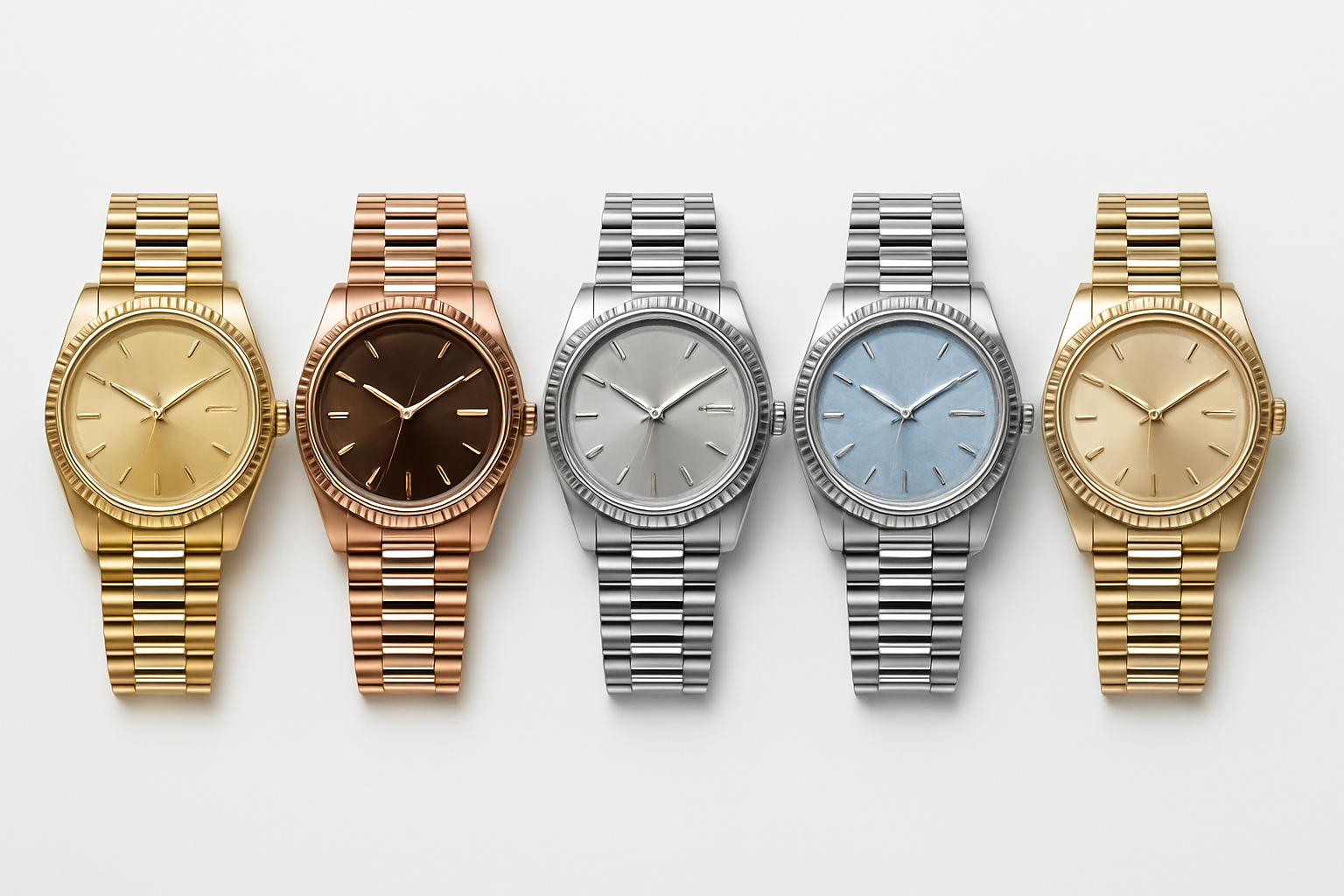
Choose the metal according to how visible the watch should be, then judge the dial according to taste, documentation and originality. The President bracelet is central to the current Day-Date identity, but its condition and completeness become separate buying questions on older watches.
Two official Rolex descriptions must be read together. The general collection overview still says the Day-Date has only been made in yellow, white or Everose gold and 950 platinum. Rolex's specific 2026 release adds the new 18 ct Jubilee Gold alloy on reference 228235JG, so the newer model-specific source provides the current answer. (newsroom.rolex.com)
Do you want the watch to read immediately as gold?
Yellow gold provides the collection's most recognizable combination, especially with a champagne dial and fluted bezel. Everose gold softens the contrast and works particularly well with chocolate, slate and darker dials.
Jubilee Gold sits between familiar categories. Rolex describes the 2026 alloy as combining soft yellow, warm grey and delicate pink tones. It is currently a Day-Date 40 proposition, not a replacement for yellow or Everose gold across the collection. The reference 228235JG model page shows the complete specification. (rolex.com)
Do you prefer a quieter precious-metal case?
White gold is the discreet option for a buyer who wants the Day-Date's weight and finish without an overt yellow or pink tone. Platinum is similarly restrained from a distance, but its mass and ice-blue dial associations give it a distinct identity.
The difference between white gold and platinum should be verified from the reference and documentation, not guessed from photographs. Lighting, polishing and image processing can make the metals difficult to distinguish on a screen.
How much risk is hidden in an unusual dial?
Rolex has produced sunray, lacquered, ombré, natural-stone, meteorite and gem-set Day-Date dials. The manufacturer's history records stone dials including lapis lazuli, malachite, tiger's eye, onyx, coral and turquoise during the 1970s, and current pages continue to show stone and diamond-set configurations. (rolex.com)
A rare-looking dial is not automatically a rare factory dial. Request clear dial photographs, the complete reference, service records and a written statement identifying any refinished, replacement or aftermarket parts. A factory gem-set watch and a conventionally configured watch modified after sale are different purchases.
Is the President bracelet complete and in good condition?
The current President bracelet uses semi-circular three-piece links and a concealed Crownclasp. Rolex states that the bracelet was created for the Day-Date's 1956 launch, while vintage auction records show that some older references were also delivered or later worn on straps and other bracelet styles. (rolex.com)
Check link count, clasp references, wear between links and whether the bracelet is original to the stated configuration. A watch head offered at an attractive price can become a very different proposition once a suitable precious-metal bracelet is added.
Choose the metal for daily presence, but judge an unusual dial by documented factory originality.
What specifications do current Day-Date models share?
Current Day-Date 36 and Day-Date 40 models are technically closer than their sizes suggest. Both use calibre 3255, provide approximately 70 hours of power reserve and carry a stated water-resistance rating of 100 metres. (newsroom.rolex.com)
The shared current specification includes:
- A self-winding mechanical calibre 3255.
- Instantaneous day and date displays with secure rapid-setting.
- Stated precision of minus 2 to plus 2 seconds per day after casing.
- Approximately 70 hours of power reserve.
- A sapphire crystal with a Cyclops lens over the date.
- A screw-down Twinlock crown and 100-metre water-resistance rating.
- A President bracelet with a concealed Crownclasp.
- A day display offered in 26 languages. (rolex.com)
Rolex strengthened its Superlative Chronometer certification in 2026 by adding testing criteria covering resistance to magnetism, reliability and sustainability. Those criteria supplement the precision, waterproofness, self-winding and power-reserve requirements established when the certification was redefined in 2015. (newsroom.rolex.com)
A vintage watch should not be treated as water-resistant merely because the reference had a stated rating when new. Gaskets, crowns, crystals and service history change over time, so a current pressure test is necessary before exposing an older Day-Date to water.
Current Day-Date 36 and 40 models share calibre 3255, 100-metre water resistance and an approximately 70-hour power reserve.
How much does a Rolex Day-Date cost in 2026?
A Rolex Day-Date price belongs to an exact size, metal, bezel and dial configuration, not to the collection name alone. Manufacturer list price helps compare new configurations, but it does not establish the worth of a particular pre-owned watch.
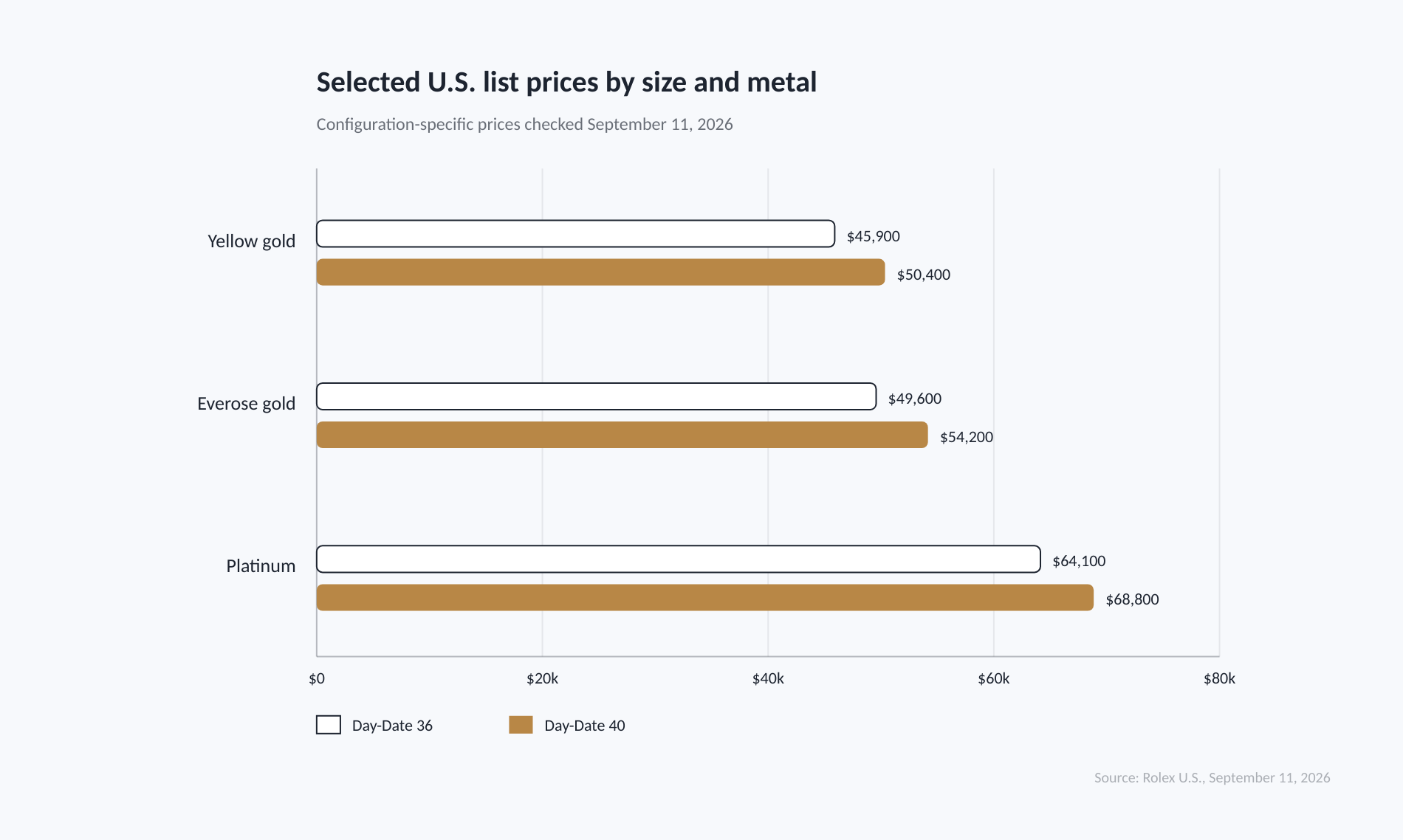
Source: Rolex U.S. Day-Date catalog, checked September 11, 2026. (rolex.com)
Selected visible configurations included a yellow-gold Day-Date 36 at $45,900, an Everose-gold Day-Date 36 at $49,600 and a platinum Day-Date 36 at $64,100. Comparable Day-Date 40 entries were $50,400 in yellow gold, $54,200 in Everose or white gold and $68,800 in platinum. (rolex.com)
Within those selected metal pairs, moving from 36 mm to 40 mm added $4,500 in yellow gold, $4,600 in Everose gold and $4,700 in platinum. Diamond-set bezels, gem-set hour markers and natural-stone dials can move the price far beyond these examples.
The 2026 Jubilee Gold reference 228235JG was listed at $61,000 with a gold-leaf design dial, while the light green aventurine version appeared at $65,700. These are new-watch U.S. prices for specific configurations, not a general Jubilee Gold price. (rolex.com)
Pre-owned worth depends on the exact reference, factory originality, case condition, bracelet wear and completeness, service history, accompanying box and papers, seller terms and the evidence available for the watch. A dealer's asking price is also not proof that another example is worth the same amount.
Use MSRP to compare configurations, not to declare what a particular pre-owned Day-Date is worth.
What should you check before buying a pre-owned Day-Date?
Verify the watch's identity and condition before negotiating around the price. The reference, dial, bracelet and transaction terms should agree with one another and with the seller's written description.
- Record the complete reference. A listing that stops at Day-Date 36 or President leaves the movement, metal and generation uncertain.
- Confirm the calendar-setting behavior. An 1803 is slow-set, an 18038 provides a quick-set date, and the 18238 and 118238 generations provide double quick-set adjustment. Unexpected behavior may indicate an incorrect description or a watch requiring attention. (sothebys.com)
- Identify every non-original component. Ask whether the dial, hands, bezel, crystal, crown or bracelet has been refinished, replaced during service or modified after sale.
- Inspect the case shape. Clear photographs should show the lugs, bezel, case sides, hallmarks and space between the lugs. Heavy polishing can soften edges and remove metal.
- Inspect the bracelet separately. Request the link count, clasp markings, total fitted length and close views of wear between the links. Confirm whether loose links are included.
- Test the day and date change. Confirm that both displays advance correctly and that the installed day language matches the listing.
- Request service and testing evidence. A recent movement service, timing report and pressure test answer different questions. One document should not be presented as proof of all three.
- Read the transaction terms before paying. Confirm the seller's identity, payment recipient, shipping insurance, inspection period, return policy and the process for resolving a material discrepancy.
DreamChrono provides dealer listings, seller-controlled prices, direct payment and direct communication with customers. The accessible marketplace pages checked September 11, 2026 did not describe platform-held escrow, platform authentication or platform condition testing, so those protections must not be assumed. Confirm inspection, payment and return arrangements directly with the seller. (dreamchrono.com)
A safe shortlist is built from verified reference, originality, condition and transaction terms, not photographs alone.
Are any Rolex Day-Date watches available on DreamChrono now?
No Rolex Day-Date was visible in DreamChrono's accessible marketplace inventory on September 11, 2026. The page displayed 24 watches from three stores, and its visible brand facets listed Oris, Bulova, Zenith, IWC and Omega rather than Rolex. (dreamchrono.com)
The marketplace search supports a reference number or watch name, as well as brand and collection fields. Useful searches include 128238, 128239, 228238, 228239, 18038 and 18238 because an exact-reference query avoids relying on inconsistent seller naming.
Marketplace inventory can change whenever a dealer adds or removes a watch. The absence of a visible Day-Date at this check is not evidence that the collection will remain unavailable, and the page should be checked again on publication day.
Treat Day-Date availability on DreamChrono as a dated observation, not a promise of permanent stock.
What else do buyers ask about the Rolex Day-Date?
Buyers frequently ask about value, affordability and whether the Day-Date justifies its price. Each answer depends on separating the exact watch and transaction from the collection's nickname.
How much is a Rolex Day-Date worth today?
Rolex Day-Date value depends on reference, metal, dial originality, condition, bracelet completeness, service history and seller. On September 11, 2026, selected new U.S. list prices included $45,900 for a yellow-gold Day-Date 36 and $50,400 for a yellow-gold Day-Date 40, but pre-owned worth cannot be inferred from MSRP alone. (rolex.com)
What is poor man's Rolex?
The phrase “poor man's Rolex” is an informal and often dismissive label, not a watch category or valuation method. The phrase does not help with a Day-Date purchase. Compare the exact reference, movement, materials, condition and documented originality instead of using a nickname that says nothing reliable about quality or market value.
Is a Rolex Day-Date worth it?
A Rolex Day-Date is worth considering when the buyer specifically wants a precious-metal day-and-date watch, accepts its weight and visibility, and values the President bracelet and reference history. It is not automatically worth the price as an investment; the decision should rest on fit, condition, originality and the exact transaction.
What Rolex can I buy for $5000?
$5,000 is not a realistic budget for a new Rolex Day-Date in the United States as of September 11, 2026; the lowest selected Day-Date configuration visible in Rolex's U.S. catalog was $45,900. A Day-Date advertised near $5,000 needs especially careful checks for condition, authenticity, completeness and undisclosed aftermarket parts. (rolex.com)
The useful answer always returns to the exact reference, condition and transaction, not the collection nickname.
What should you do next?
Choose one preferred reference and one fallback, then compare only listings that disclose the same core facts. A current-model shortlist might pair 128238 with 228238, while a vintage shortlist might pair 18038 with 18238.
Use the complete reference to search current DreamChrono marketplace listings. If no matching watch appears, retain the shortlist and check again later rather than substituting an unfamiliar configuration simply because it is available.
Search by the complete reference and walk away from any listing that cannot explain its dial, bracelet, condition and transaction terms.